Tokyo Part 5: Things to Do in the Big Mikan
- The Anonymous Hungry Hippopotamus
- Feb 22
- 6 min read
Armed with a brief introduction to Tokyo and several restaurant suggestions from my previous posts, you may be wondering what activities and sightseeing opportunities Tokyo has to offer. In addition to a trip to Shibuya to watch the famous Shibuya Scramble crossing and to Toyosu Market, for excellent sushi at the world's largest seafood market (both of which I have already written about), below are three suggestions for things to do while in Tokyo.
Take in the View
First, take in the view. You can do this from a ground level, by visiting popular places such as those mentioned above, as well as Asakusa, where you will find Tokyo's oldest temple, Akihabara, the center for anime and electronics and Ginza, the luxury shopping district.

Tokyo Tower
If you're looking for a bird's eye view however, I have two suggestions. First, Tokyo Tower, a 1,093 foot tower in Minato, Tokyo.

Tokyo Tower was completed in 1958 and has two observation decks with panoramic views. I saw the tower from afar, but did not visit.

View of Tokyo Skytree from Spacia X
Instead, I visited Tokyo Skytree, a newer and taller tower. My nephew pointed it out to me from the window of the Spacia X train.

As we got closer, he told me he really wanted to visit and I promised to take him, despite my documented fear of heights. This seemed like a great idea as I was staring into his excited and adorable face from the safety of the train.

Then we arrived at Tokyo Skytree, where I made the mistake of looking up at the tower. I immediately questioned my judgement.
Mural of Tokyo Skytree View
As we stood in line, my nephew avidly rattled off facts about Tokyo Skytree that he learned in school. Among them was the fact that, at 2,080 feet, it is the world's tallest freestanding broadcast tower and it is also Japan's tallest building.
Why had I agreed to this? Love for my nephew, that's why. That love did not stop my sweaty palms and increased heart rate, however.
Tokyo Skytree Elevator
Those only increased when we got into the elevator to ride up to the observation deck. I tried to pretend I was in any ordinary elevator, ascending just a few stories. My plan was foiled because a video in the elevator diligently reported every meter we rose and the speed at which we were traveling. It's fascinating in retrospect I admit, but was truly anxiety provoking for me in the moment.

View of Sumida River from Tokyo Skytree
The elevator doors opened and we stepped out to a stunning view of Tokyo through floor to ceiling windows.

View of Tokyo Bay from Tokyo Skytree
We walked all the way around the circular observation deck, taking in the view from every perspective. Among many sites, we were able to see Tokyo Bay, Rainbow Bridge, Roppongi Hills and even a bit of Mount Fuji, though on clearer days, this is an ideal place from which to see the iconic mountain in its entirety.
I think in total, we spent about 45 minutes between the two observation decks, the Tembo Deck at 1,148 feet and the Tembo Galleria at 1,476 feet. Throughout the time, I was surprisingly calm and thoroughly enjoying the time with my nephew, as well as the view.

Tembo Galleria Glass Floor
That was until I noticed the glass floor in one section of the Tembo Galleria, over which you can walk, or through which you can gaze down about 150 stories to the ground below. With knees shaking and a dry mouth, I told my nephew it was time to go. By that point, he was thankfully ready to head home as well.

Sumida River Sunset
I felt like myself again as soon as we exited the Skytree lobby. As we headed back home to Meguro, I had a newfound appreciation for solid ground. Oh, and the sunset wasn't bad either.
Pig Out

Mipig Micro Pig House
The second activity I'd recommend is to pig out. Not as in eating copious amounts of food. That activity was already highlighted in my last three post.

By "pig out," I mean, hang out with pigs. I suppose you could also stuff your face, since the venue offers food and drinks, but that's not really the point at these animal cafes that you can find throughout major Japanese cities.
The casual venues offer a chance to spend time with animals ranging from cats and dogs to hedgehogs, reptiles, owls and more. Since I have plenty of exposure to cats and dogs in the U.S., I decided to venture out and hang with another animal. I chose micro pigs, and with that, we headed to Mipig Cafe in Harajuku, Tokyo.

There were a lot of pigs at the venue. Small ones, ...

... larger, curious ones, ...
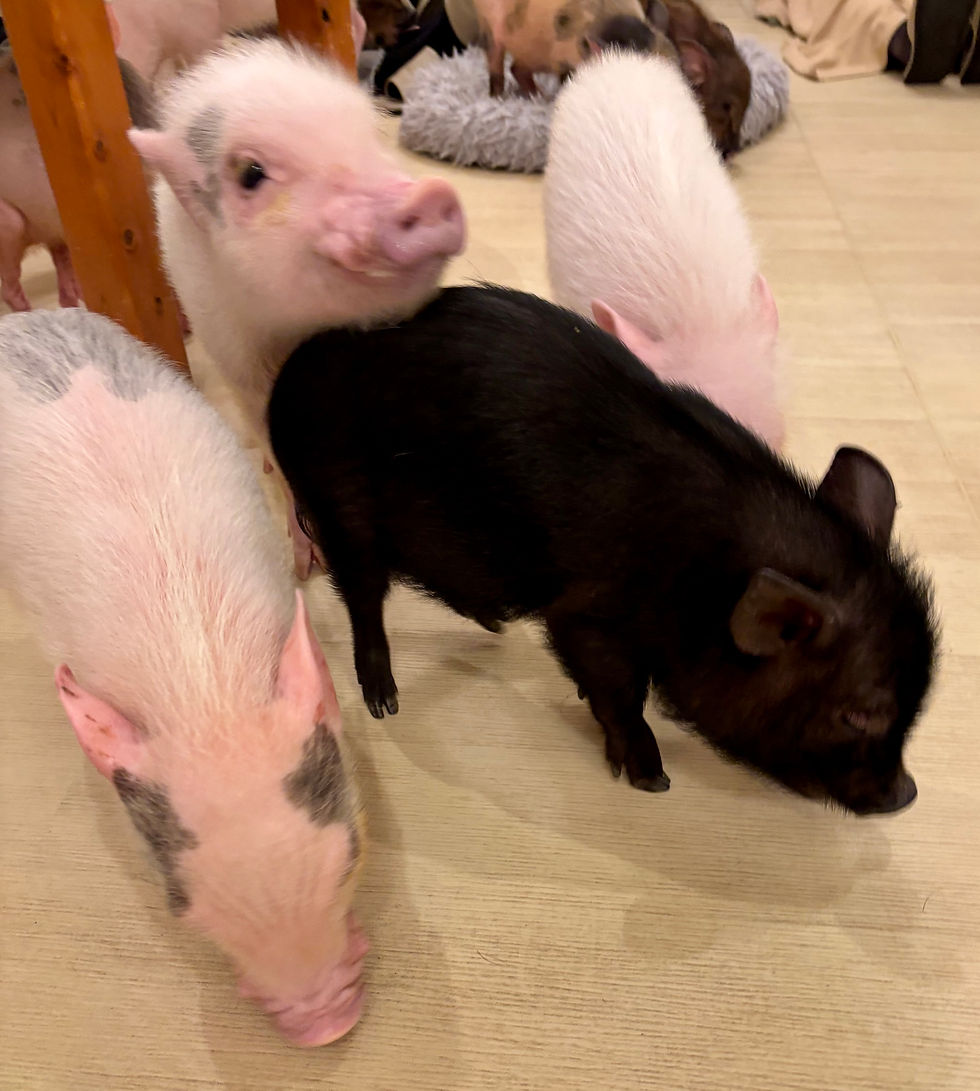
... and social ones who traveled in packs.

All of them got close. Very close. It was a little alarming to be sitting on the ground (which is required) with so many pigs approaching confidently and some even opting to sit or crawl on you. Ok, I was more than alarmed. I was uncomfortable and a little scared.
When you watch the video, you'll understand what I mean. That was me squealing, not the pig. But, did you see the girl laughing and cowering in the corner at the beginning of the video? I'm just saying, I wasn't alone.
Though a little unnerving, I'm grateful I went. After all, how many chances am I going to get to dine with, as opposed to on, pigs?
Fix Something Broken

Kintsugi Class
My final activity suggestion in Tokyo is to fix something that's broken. I did this via a kintsugi class I took with my cousin's wife, who was kind enough to find a studio and book our lesson, knowing that this is an art I have appreciated for at least a decade.

Kintsugi, or "golden joinery" is a Japanese art form wherein, rather than disposing of broken pottery, the pieces are joined back together with gold, silver or platinum.

Instead of hiding the damage, the technique actually highlights the cracks to celebrate the history and imperfections of the object. The art form is rooted in the philosophy of wabi-sabi, or finding beauty in imperfection. That is worth reflecting on deeply.
To begin the process, an instructor demonstrated how to file the surface of the cracks until smooth, so that ...
... after applying glue, the broken pieces would reattach easily.

As I sat waiting for the pieces to adhere to one another, I prayerfully thought about the beauty of embracing brokenness as a part of our story. Not letting it define us of course, but honoring that part of the journey, instead of shamefully treating it as a flaw to be concealed.

My reflections were interrupted because my plate was ready for the next step. There was still a missing piece and therefore a gap to be filled.
An instructor showed me how to apply putty to fill the gap, ...
... and then sand it down so that it became a seamless part of my plate.
She then mixed some type of liquid with ...
... gold powder and ...
... had me stir the two together until they were completely incorporated. As I say in the video, I enjoyed the brief foray into alchemy.
Finally, it was time to apply the gold to highlight, not cover, the cracks. That is an important distinction, maybe even a complete paradigm shift for some.
I waited, both for the paint to dry, and for my green tea to steep.
As I sipped on my hot tea, I thought about how the painful parts of life's journey, graciously taught me long ago that our scars, losses and setbacks do not diminish our worth. Instead, and only if we let them, they will deepen our character and make us uniquely beautiful. That said, sitting with these broken fragments and piecing them back together, turned my deeply held and applied philosophy into an objective reality.

Said another way, the Biblical concept in Isaiah 61:3 of making beauty out of ashes began as a spiritual understanding for me, moved into an emotional and cerebral one through application during life's storms and then, as I sat holding a once broken plate, now illuminated by golden seams, the understanding became physical. It was as though I was holding resilience in my hands.
I am so grateful for travel, as it always stretches me, exposing me to things I would have otherwise not seen, giving me the opportunity to do things I otherwise would not do and building cognitive flexibility along the way, as I examine and re-examine my views. It's not always comfortable, but then growth never is.

Comments