Tokyo Part 2: Toyosu - The World's Largest Seafood Market
- The Anonymous Hungry Hippopotamus
- Feb 10
- 4 min read
The late, great, author, chef and traveler, Anthony Bourdain once said, "If I had to eat only in one city for the rest of my life, Tokyo would be it."

I wholeheartedly agree. And if there is a living, breathing heart of Tokyo's food culture, I propose that it is Toyosu Market.

Auction Floor, Toyosu Market
Opened in 2018 as the successor to the legendary Tsukiji Market, once the world's largest seafood market, Toyosu is now the home of the world-famous fish auctions. Buyers arrive before dawn to inspect the freshly caught fish that arrive from waters far and near.
At the center of it all are the prized tuna that are judged and priced based on their perfect balance of fat, color and texture. In January, at the first auction of 2026, the most expensive tuna ever purchased was bought here, at the Toyosu Market auction. The fish fetched a staggering 510.3 million yen, the equivalent of $3.2 million USD.

Toyosu Market
Toyosu Market is located on an island of reclaimed land in Tokyo’s Kōtō Ward. It's difficult to convey the scale of this market.
Even the video above doesn't do it justice. Toyosu is comprised of three interconnected buildings that span 4.4 million square feet, making this, the largest fish market in the world. Within this space, Tokyo's inextricable and beautiful relationship with the sea becomes evident.

Sho Sushi
Bidding on fish at the auction was entirely out of the question for me obviously, but tasting them was not. We took a short walk across the building to the third floor of Block 6 where over 20 of Tokyo's best sushi restaurants awaited us, including Sho.
Sho is an Edomae sushi restaurant, meaning that they specialize in the traditional Tokyo-style, sushi technique that originated in the 1800s. We sat down at the sushi bar for an omakase dining experience, my first since arriving in Japan the day before. I couldn't have been more excited.
Wasabi Preparation
Sitting at the sushi bar, I got to watch the master's obsessive dedication to quality. Take for example the wasabi, which Americans are accustomed to squeezing out of a tube or plastic packet at home, or alternatively, digging from a small, dry lump adjacent to some ginger at a restaurant.
Here, at Sho, I watched the sushi chef grate the wasabi root by hand on sharkskin. The extremely fine, sand-paper like surface preserves the delicate texture and flavor of the wasabi and releases fleeting aromas. The taste is gentle, with a quickly fading heat that enhances, rather than overpowers the fish.
Nigiri Preparation
It is the chef that chooses the perfect, complementary amount of wasabi and then places it directly between the rice and the fish, just before gently painting the top of the fish with soy sauce. This prevents over-salting and protects the integrity of the rice and the fish.
This is how sushi is meant to be enjoyed. Wasabi should not be mixed into soy sauce and then used as a dip. This destroys both the soy sauce and your palate, so that it cannot decipher the subtle flavors of the fish. If you must dip, turn the nigiri upside down and dip only the flesh of the fish in the soy, never the rice.
I don't recommend it, however. I recommend trusting the chef with wasabi and soy application, which is incidentally what "omakase" means - "I'll leave it to you" or "I trust you."


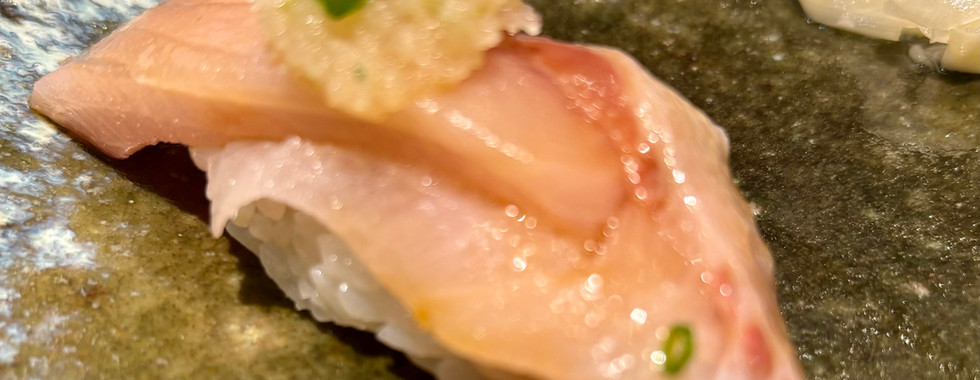

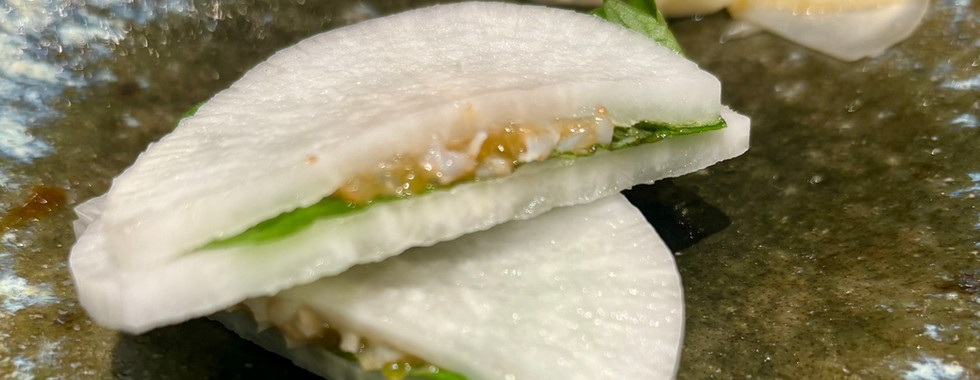


Sho Sushi Omakase
Trust him I did, and the result was the best omakase I had experienced up to that point. Everything was perfect from the warm, vinegared rice to the melt-in-your-mouth fish. This is a meal I will always remember.

Toyosu Senkyaku Banrai
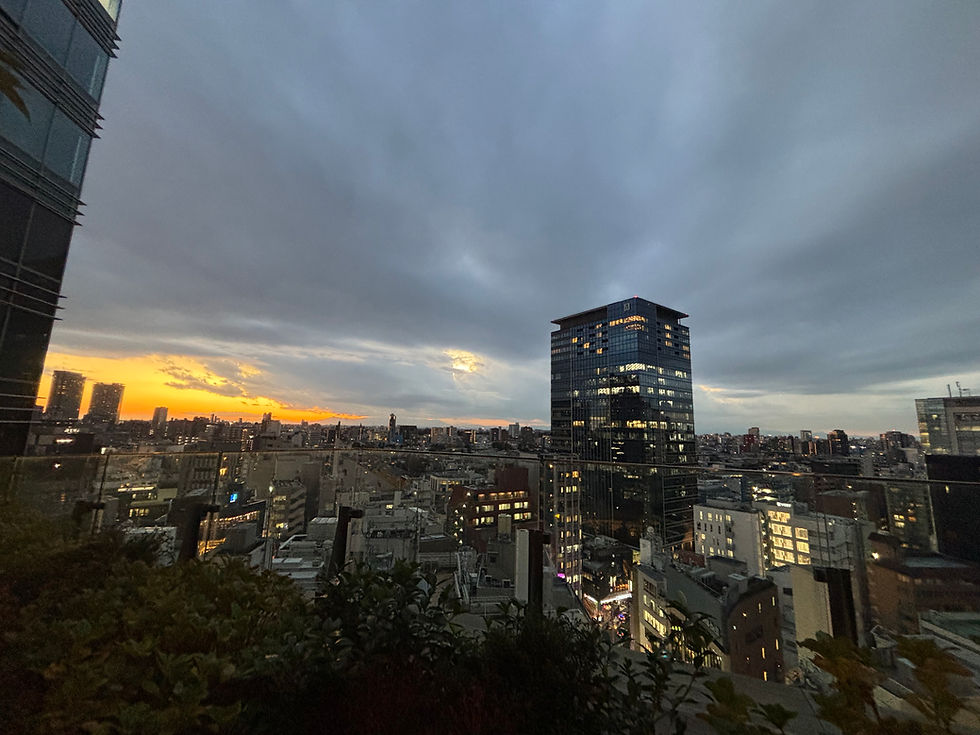
Adjacent to the Toyosu Market is the Toyosu Senkyaku Banrai complex. This outdoor market recreates Edo period streets and is filled with vendors selling more seafood, snacks and dessert. There's even a public, outdoor, natural hot spring foot bath on the eighth floor that has lovely city views. Oh, and did I mention that it's free?

Yame Matcha Mont Blanc Cake
We came for dessert, not a foot bath though, and decided on a matcha dessert from Hamakaze Sabo, a shop specializing in yame matcha. Yame is a very high quality, shade-grown, green tea from the mountainous, Yame region in Fukuoka. It has a sweet, creamy and earthy taste.
We ordered the yame matcha mont blanc cake which starts with a sponge cake filled with chestnut cream, covered in matcha cream. A yame matcha and chestnut puree is then piped over the cake in spaghetti strands.

The dessert is rich in matcha flavor, creamy, light and has a consistency that lies somewhere between a sponge cake and mousse. We ended our trip to Toyosu Market and Senkyaku Banrai on that sweet note.
Final thoughts on this adventure:
Experiencing Toyosu Market opened my eyes to how deeply the sea is woven into Japanese culture. In one space, I could see the journey begin with the fisherman that haul in their catch, to the skilled sushi chef's who transform it into something sublime. To stand in Toyosu Market amidst the subtle scent of the sea, I got to see firsthand, the living, culinary network that connects Tokyo - and Japan itself - to the rest of the world.


Comments