Best Things to Do in Kyoto: Kiyomizu-dera, Fushimi Inari, the Shinkansen Journey and More
- The Anonymous Hungry Hippopotamus
- Mar 9
- 5 min read
Updated: 1 day ago
The Journey: Tokyo to Kyoto by Shinkansen

I boarded the Shinkansen in Tokyo and headed west toward Kyoto, leaving behind the glass towers and relentless motion of Japan's modern capital for a city shaped by temples, shrines, and more than a thousand years of history. The journey itself felt like part of the experience. Traveling aboard the Shinkansen is one of the quiet pleasures of Japan—an exercise in efficiency, punctuality, and comfort that turns even a cross-country train ride into something worth savoring.

Like many travelers in Japan, I made a brief pilgrimage to a nearby 7-Eleven before boarding. In most countries, convenience stores are places of necessity. In Japan, they are destinations unto themselves.

Ham and Egg Sandwich
The shelves were stocked with neatly wrapped onigiri, delicate sandwiches, and surprisingly sophisticated bento boxes.

Unagi with Brown Rice, Sancho Pepper and Pickled Radish
I chose grilled unagi with brown rice, sancho pepper, and pickled radish—a meal that would have felt perfectly at home in a casual restaurant. There are few travel experiences more distinctly Japanese than eating a thoughtfully prepared lunch while gliding across the countryside at 200 miles per hour.

Mount Fuji
I ate my grilled unagi sprinkled with sancho pepper silently while enjoying the view from the large windows that framed fleeting glimpses of countryside and mountains. Along the way, I got a breathtaking and unexpected view of Mount Fuji.
Kyoto Station

Kyoto Station
Kyoto Station was my first surprise. For a city celebrated for wooden temples, stone gardens, and centuries-old traditions, its main gateway is unapologetically modern. Completed in 1997, the vast steel-and-glass structure rises like a futuristic cathedral, filled with soaring atriums and elevated walkways that seem designed as much for spectacle as transportation. It is an unexpected introduction to Kyoto, and perhaps the perfect reminder that Japan rarely forces visitors to choose between past and present.
Escalators placed dramatically in the center of the station climb upwards toward the rooftop observation deck.
Kyoto Station Rooftop
The rooftop not only provides a peaceful, green space for the weary traveler, but ...

... from here you can see the Kyoto skyline, including Kyoto Tower.
Kyoto Tower

Kyoto Tower
Located just across from Kyoto Station, the tower was one of my first stops in the city.

Built in 1964, Kyoto Tower resembles a birthday candle set atop a building full of shops and restaurants.

While impressive, Kyoto Tower is modest in comparison to Tokyo Skytree, which I visited in Tokyo. Kyoto Tower rises 430 feet in comparison to the imposing Tokyo Skytree, which reaches more than 2,000 feet. This underscores the point I was making in my last post about Kyoto's quieter and more restrained personality.

Though smaller in stature, from this height I could still see the city of Kyoto stretch for many miles toward the mountains.
Kiyomizu-dera

Kiyomizu Temple
And to the mountains is where I will take you next. Perched on the wooded slopes of Mount Otowa in eastern Kyoto is Kiyomizu Temple.

Pagoda
Founded in 778, Kiyomizu-dera is one of Kyoto's most revered temples filled with architectural marvels like this three story pagoda built in 1633. It stands over 100 feet high, making it one of the tallest of its kind in Japan.

Kiyomizu-dera means "Pure Water Temple," a name given because of its proximity to the nearby Otowa Waterfall.
The waterfall fills the streams that run through and around the temple grounds.

Those waters also flow into this stone basin from three distinct streams believed to grant longevity, academic success and fulfillment of love.
Many visitors used these long-handled cups to draw what they believe is sacred water from one of the three streams. It is considered bad luck to draw from all three.

Seiryu
Seiryu, or the Azure Dragon sits near the entrance at the West Gate representing the legend that a blue dragon visits the temple nightly to drink from its waterfall. Near another temple entrance, you'll find Tainai Meguri, a pitch-black, underground passage. For a fee, you can remove your shoes and navigate the complete darkness of the narrow corridor by holding a long, thick, beaded rope until you reach the light at the other side. The walk represents a journey into the womb of a female Bodhisattva and symbolizes rebirth from darkness to light.

Though I didn't partake in any of the temple related rituals, I found the grounds beautiful and the architecture and decor stunning.

From the golden, tsuri-dōrō, or hanging lanterns, in the hallways, ...

... to the stone statues in the garden, I was taken with it all.
The Wooden Stage

Kiyomizu No Butai
It was the temple's wooden stage that most impressed me though. Appreciated best from afar like in this photo, it is an engineering marvel. The stage extends more than 40 feet over a steep cliff, supported by wooden pillars. It was created using traditional Japanese carpentry, without a single nail. The grid like support system is flexible and earthquake resistant highlighting the sophistication of the Kakezukuri technique.
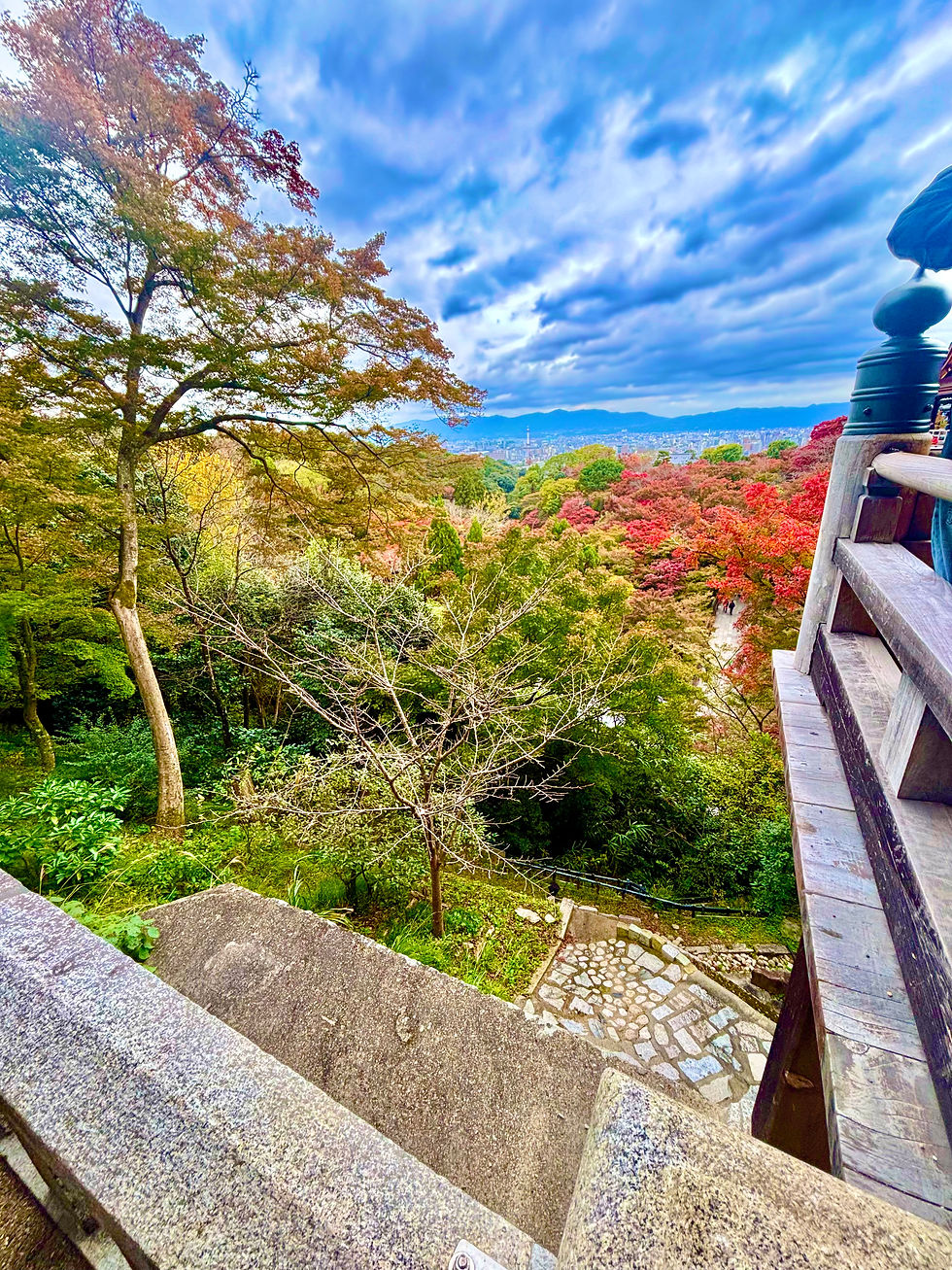
I suggest visiting, if for no other reason than to take in the views at this UNESCO World Heritage Site where nature, spirituality and traditional craftsmanship converge.
Sanjūsangen-dō Temple

Shinto Shrine
Next I headed to Sanjūsangen-dō Temple, passing by this Shinto Shrine along the way. Though Shintoism and Buddhism are separate religions with different origins, shrines and temples, they are often seen in close proximity and sometimes share the same grounds in Japan.
Shinto is Japan's indigenous, animistic faith, whereas Buddhism originated in the eastern Gangetic plain of the Indian subcontinent, which is present day India and Nepal. In Japan, the two faiths have been intertwined for over a thousand years and together are referred to as shinbutsu shūgō.

Shrine Gate
This is the gate of Sanjūsangen-dō Temple, originally founded in the 12th century and later rebuilt in 1266 after a fire.

Sanjūsangen-dō
In comparison with other temples I visited in Japan and Thailand, Sanjūsangen-dō did not immediately capture my attention architecturally.

Then I learned that Sanjūsangen-dō's main hall stretches about 390 feet, making it the longest, wooden temple hall in Japan. In fact the name Sanjūsangen-dō translates to "Hall of Thirty-Three Bays."
Inside the dimly lit hall, you will find 1,001 statues, arranged in perfect symmetry, of Kannon, the Buddhist deity of mercy.
While the temple's structure is angular and long, the surrounding grounds provide a soft counterpoint. There you will find a reflecting pond, carefully tended gardens and stone paths where you can walk, pause and absorb the serenity.
Fushimi Inari Shrine

Senbon Torii
Last, but certainly not least, no visit to Kyoto feels complete without ascending the vermilion corridors of Fushimi Inari Taisha. The thousands of torii gates rise in rhythmic succession up the wooded slopes of Mount Inari. Indeed, this is one of the most recognizable images of Kyoto.
The gates create a tunnel of surrounding color that is mesmerizing, broken up only by the shafts of light peeking through the trees and posts overhead.

Though the individual gates form one seamless corridor, each one is unique because each has been donated and inscribed.

Kitsune
Throughout the shrine, you will find statues of foxes who are believed to be messengers of the Shinto deity, Inari who is associated with agriculture and prosperity. This was the final fox I encountered at Fushimi Inari as I walked down the hill and the day drew to a close.
My Kyoto journey is not over. Up next are more sites to see and things to do, including my favorite place in this "City of Ten Thousand Shrines."


Comments