Kikunoi Roan: A Masterclass in Kyoto Kaiseki (Kyoto, Japan)
- The Anonymous Hungry Hippopotamus
- Mar 3
- 4 min read
Updated: 4 hours ago

Kikunoi Roan
I'm launching my series about Kyoto with a restaurant, which I don't ordinarily do. Coming soon will be information about the city, things to do and all the other elements I customarily include when I review a place.
For now however, I feel compelled to write about Kikunoi Roan (also called Roan Kikunoi), a restaurant that I am including in both this Kyoto series and my series of "Greatest Hits," because it easily qualifies as one of the top 50 restaurants I have been to.

Why the urgency? Interestingly, I have no less than ten friends who will be visiting Kyoto within the next several months and have requested recommendations. If they, or any of you reading this, want to eat at Kikunoi Roan in the near future, I recommend booking a reservation now, because like me, everyone seems to love this place, and for good reason.

Kikunoi Roan is a Michelin, two star restaurant. It is the sister restaurant of three star, Kikunoi Honten. While Honten focuses on more classical dishes in a formal setting, Roan is a tad more casual and incorporates subtle, contemporary twists on its menu.

Sake Service
Both Kikunoi Roan and Honten are kaiseki restaurants. Kaiseki is an exquisite, multi-course, cuisine focused on seasonal and locally sourced ingredients. If you're thinking this is your basic, farm-to-table dining story, you are on the right track, but barely.
What is Kaiseki?

Sake with Yuzu Fragrance
Kaiseki is the pinnacle of Japanese haute cuisine, refined over centuries in Kyoto and deeply influenced by Zen aesthetics and the formal structure of a Japanese tea ceremony. While it may have roots as a modest, pre-tea meal, today, it is a highly codified, culinary art form where flavor, color, texture, seasonality, and presentation are balanced with ceremonial discipline.
The Menu

Steamed Crab
A kaiseki meal tells a quiet, deliberate and precise story about the season and geography of a place. This narrative food arc divulged the secrets of Kyoto and the surrounding region without uttering a word. The story began with the kobako-kani snow crab, a highly prized, female, roe-bearing crab with intense flavor, that is only available for about two months beginning on November 6th .
While the meat of this crab is delicious, it is actually the crab's orange eggs and creamy innards that offer the potent flavor. The kobako-kani, also called "the little jewel box," in this presentation was steamed and served over sticky rice.

Assortment of Appetizers
Next, I was handed a wooden box with a singular ginkgo leaf placed atop.
Inside was a treasure trove of seasonal delights, including duck liver pate with white poppy seeds, karasumi (dried mullet roe), kuwai (arrowroot chips), sake-glazed gingko nuts with rice cake flour, poached anglerfish liver, wasabi greens, shimeji mushroom and grilled prawn.

Cuttlefish
The most mind bending of the contents were the maple leaf shaped cuttlefish coated with egg yolk ...
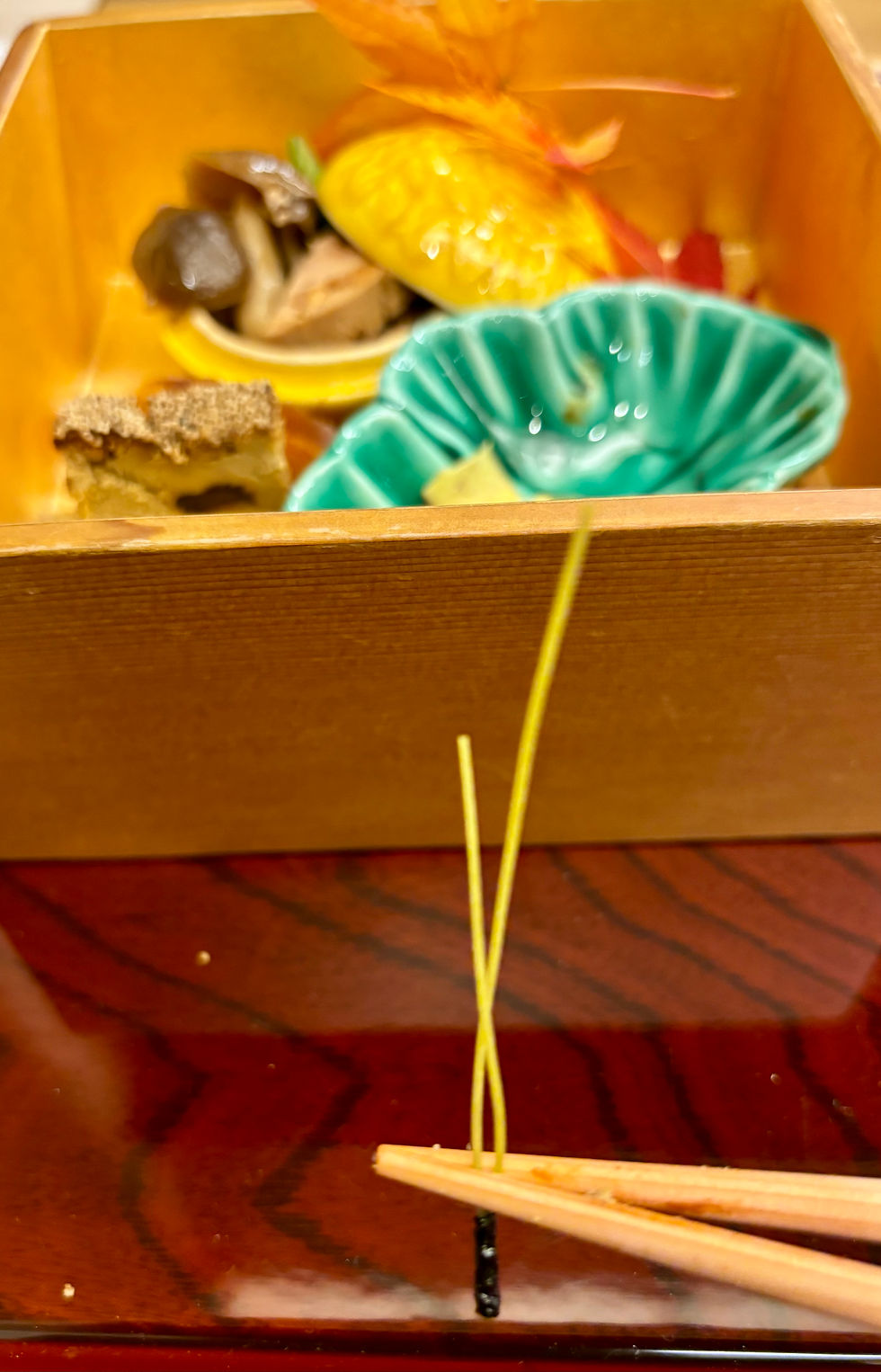
Matcha Noodles
... and the pine needle shaped tea noodles. The sheer artistry astounded me.

Tai and Tsubasu Sashimi
Following the appetizers were two sashimi courses. The first was a plate of tai (red sea bream) and tsubasu (young yellowtail), served with chrysanthemum petals and wasabi that was freshly grated on shark skin, a very fine abrasive that preserves the delicate flavor and texture of the root.

Bluefin Tuna Sashimi
The second sashimi course was bluefin tuna with a dab of hot mustard.
The fish was served alongside a creamy, dipping sauce made of soy-marinated, egg yolk.

Dumpling Soup
That unctuous course was balanced by a steamed, shrimp and chestnut dumpling in a very light broth that included gingko nuts, kintoki carrots and mibuna, a slightly spicy and bitter leafy green. The soup was garnished with chrysanthemum petals and yuzu peel.

Next, it was time for another packaged treasure.
Kamasu
The chef unwrapped the cedar envelope with care. Inside was miso marinated kamasu (barracuda) and some Shitake mushroom, both carrying the slightest smoky flavor, imparted by the lightly toasted cedar in which they were encased.

Yuzu Tofu
The seventh course was an ode to the yuzu fruit, a highly aromatic, citrus fruit, native to Japan and China. Mizuo, a village in northwestern Kyoto, is the historic birthplace of yuzu cultivation in Japan.
The fruit, which is harvested in late autumn and early winter, was used to make a silky yuzu tofu, flavored with yuzu miso sauce and some diced yuzu. The dish was served inside a hollowed yuzu rind.
Hot Pot
Following the citrus palate cleanser, the chef presented a bubbling, Kyoto-indigenous, vegetable hot pot. The broth was flavored with kintoki carrot (a red, heirloom variety), ebi-imo (premium Kyoto taro), turnip and kujo-negi (green onion).

To the broth, I added Napa cabbage, burdock, mushroom and guji (red wakasa tilefish).

Gohan
Gohan, or rice, was served as the final savory course, which is typical in traditional kaiseki meals. The rice was mixed with salmon roe and Japanese pickles, and finished with seaweed.

Daishiro Persimmon
The final course of the evening was a ripe, Daishiro persimmon, a prized winter delicacy in Japan. This variety of persimmon is known for being exceptionally sweet and creamy with an almost jelly-like consistency when it is at the peak of ripeness.
But for a splash of cognac, the persimmon was simply sliced in half and placed on a plate. I have had my fair share of persimmons and yet, I had never tasted one as lovely as this. Simple and pure.
What Kaiseki Taught Me
My learning from this meal is that Kaiseki operates on an entirely different and higher cultural, philosophical and technical plane than any other cuisine I have experienced. If you're paying attention, you eat with a deeper level of gratitude, knowing that the meal can never be replicated because it is anchored in that moment's landscape. Soon, the season and its ingredients will fade and something new will surface.
My kaiseki meal was an opportunity to see nature unfolding before me. As it came to a close, it dawned on me that this meal was a story about the passage of time. We can fight change with fear and dread or we can appreciate the moment before us more deeply, embracing the inevitability and beauty of impermanence. The choice is ours.


Comments