Miyajima Island, Japan: Where the Sacred Meets the Sea
- The Anonymous Hungry Hippopotamus
- Jul 7
- 12 min read
Updated: 1 day ago

There are places in Japan that photographs have made so familiar that arriving feels less like discovery and more like recognition. Miyajima is one of those places. You have seen the image — a great vermilion gate rising from the water, its reflection rippling across the Seto Inland Sea, the mountains of a forested island rising behind it. You have seen it so many times that you think you know what it will feel like to be there.
You do not. Nothing prepares you for the scale of it, or for the silence, or for the particular quality of spiritual wonder that the island produces in even the most resolutely secular visitor. Miyajima is one of Japan's Three Great Views, a UNESCO World Heritage Site, and one of the most visited places in the country.
None of those distinctions fully explains what it is. What it is, is sacred. You feel that the moment the ferry crosses the water and the gate comes into view, rising from the bay as it has for more than a thousand years.
A Brief History of the Island

Miyajima's official name is Itsukushima, which translates simply as "shrine island." The name is both accurate and insufficient, because this island has been considered sacred since long before any shrine was built on it. In the Shinto tradition, the island itself was understood to be divine.
Commoners were forbidden from setting foot on its soil for centuries. The dead could not be buried here. Pregnant women were taken to the mainland to give birth. Even today, births and deaths on the island are strictly prohibited. There are no hospitals and no cemeteries among its roughly 2,000 residents.

The first shrine is believed to have been established in 593 AD, during the reign of Empress Suiko, dedicated to three daughters of the sun goddess Amaterasu: Ichikishimahime, Tagorihime, and Tagitsuhime, deities of the sea and of safe passage. The shrine was built over the water precisely because the land itself could not be disturbed. What pilgrims could not walk upon, they could approach by boat.
It was in 1168 that the shrine achieved the form that defines it today. Taira no Kiyomori, one of the most powerful warlords of the Heian period, ordered a complete reconstruction in the elaborate shinden-zukuri style of aristocratic Heian architecture. There are spacious corridors elevated above the tidal line, interconnected buildings spanning 853 feet of shoreline, and at the entrance to the bay, the great torii gate, built in the water so that pilgrims arriving by boat would pass through it as an act of purification before reaching the shrine.

The current torii dates to 1875. It is the eighth version of a gate that has stood on this site since 1168. It stands almost 55 feet tall, weighs over 60 tons, and is constructed from camphor wood chosen specifically for its natural resistance to rot and insects. Its four support pillars are not anchored into the seabed. The gate stands by gravity alone, holding itself in place against eight centuries of tide, typhoon, and rising sea levels with a confidence that seems, like so much of Japan, to have been arranged in defiance of physics.
In 1996, the shrine complex was designated a UNESCO World Heritage Site. The G7 leaders visited in 2023. Millions of tourists arrive each year. The gate continues to rise from the water with complete indifference to the attention.
Getting There

Miyajima is reached by ferry from Miyajimaguchi, a journey of approximately ten minutes across Hiroshima Bay. From Hiroshima Station, the JR Sanyo Line reaches Miyajimaguchi in about 25 minutes. Japan Rail Passes cover the JR West ferry service, making the crossing essentially free for pass holders. Two ferry companies operate the crossing, JR West and Matsudai Kisen, and both take approximately the same time. If you are traveling between 9:10am and 4:10pm, the JR West service offers the Great Torii ferry route, which passes close enough to the gate to give you your first proper view of it from the water.
I arrived by the morning ferry, watching the island emerge from the haze of the Seto Inland Sea, the vermilion gate rising into view before I could make out much else. There are arrivals in Japan that function as their own form of ceremony. This is one of them.
Omotesando Street

The ferry deposits you near Omotesando Street, Miyajima's main shopping arcade, lined with vendors selling the island's two most famous products: fresh and grilled oysters and momiji manju, the maple-leaf-shaped cakes filled with sweet bean paste that have been made here since the Meiji era.

The street runs parallel to the shoreline and delivers you toward the shrine complex.

The deer appear almost immediately.
They are everywhere on this island, wandering through the shopping street, resting in the shade of the shrine's corridors, approaching visitors with the particular confidence of animals that have never had reason to fear human proximity. They are considered sacred messengers of the gods on Miyajima, as they are in Nara, though Miyajima's deer have a reputation for being less ceremonious about it. They will eat a map if you leave it unattended. They will investigate your bag. They treat the island as their home because it is.
Floating Torii Gate

Before I arrived on Miyajima, someone told me that at low tide you could walk directly to the base of the gate and even touch it, that visitors dug for clams in the mudflats around it, that the seabed around this iconic structure was itself a destination.
I filed this information away with mild skepticism. When I arrived, the tide was high and the gate stood in water deep enough that its base was invisible. The crossing to it looked not merely impractical but impossible. The bay between the shoreline and the gate was open water, the kind that requires a boat rather than a walk.

As the afternoon wore on, something began to happen gradually and then all at once. The water pulled back. First a narrow band of wet sand appeared at the shoreline. Then wider. Then the first rocks emerged from the bay, dark and glistening. The gate's base began to reveal itself, the camphor wood pillars, the texture of the stone around them, the centuries of tide mark staining the wood at the waterline. And then, with a slowness that felt deliberate, the mudflats between the shore and the gate opened completely.

People walked out. I walked out. The mud gave slightly underfoot, yielding in the way that tidal ground always does, and around the gate's base, visitors were indeed crouching to dig for clams, their hands disappearing into the wet sand as casually as if they were gardening. I reached the gate itself and put my hand against the wood of the main pillar. The camphor was smooth where centuries of visitors have touched it, rough where they haven't. Sixty tons. Eight hundred years of versions of this gate. Standing by gravity alone.
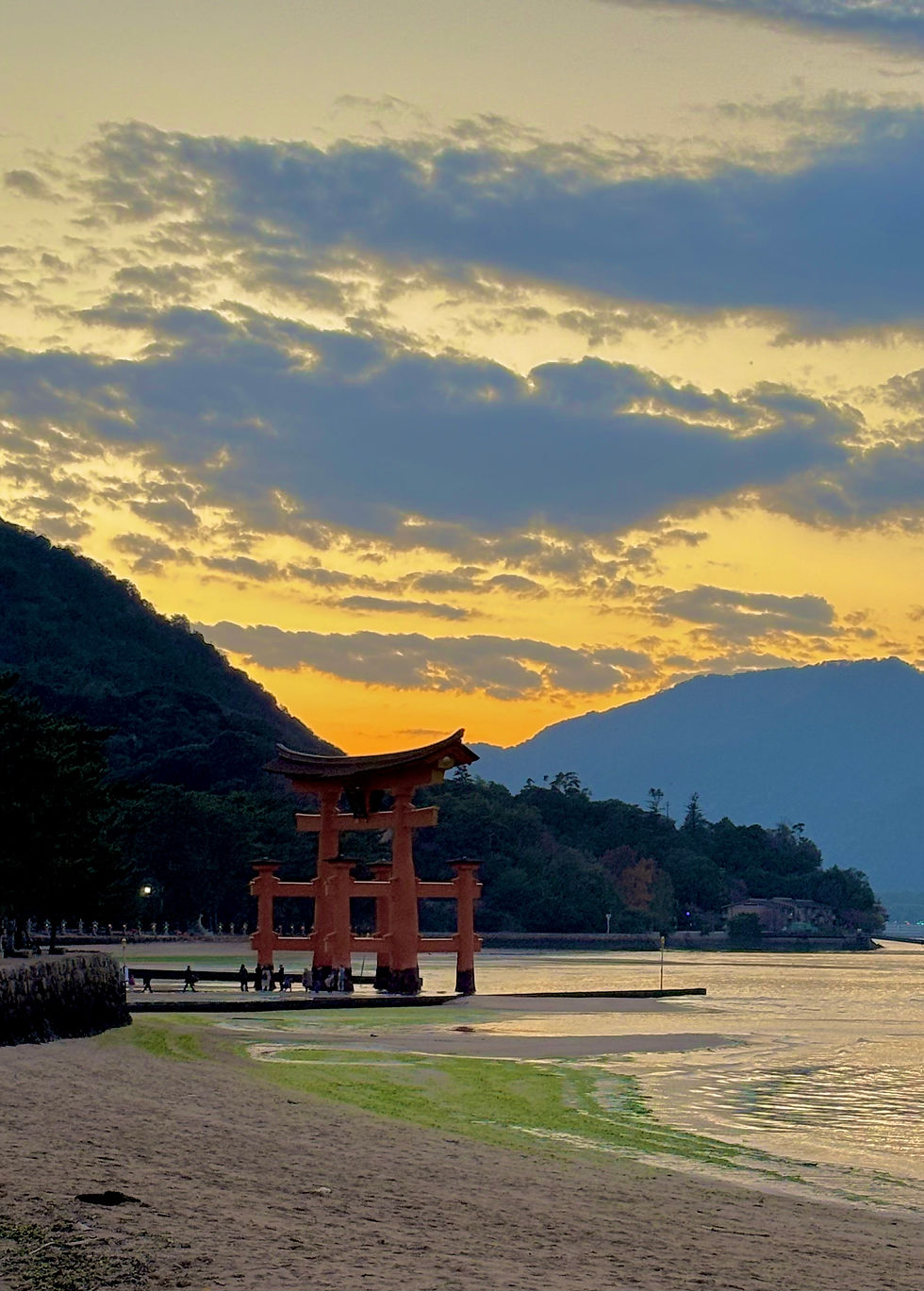
What seems impossible is often simply a matter of timing. The gate had not moved. The water had. The obstacle was never the gate. It was the tide, and tides, given time, always recede. I thought about how often what appears fixed and immovable is actually just a matter of waiting for conditions to change. Perspective shifts. Circumstances alter. Faith builds. What blocked your path this morning is, by evening, something you can touch.
Gojū-no-tō — the Five-Story Pagoda

Before you reach the shrine, the path from Omotesando Street takes you past one of the most quietly commanding structures on the island. The Gojū-no-tō, the Five-Story Pagoda, stands on a hill above the shrine complex, its red lacquer finish visible through the trees from a considerable distance.
Built in 1407 and standing approximately 27 meters tall, the pagoda is neither Buddhist nor entirely Shinto in character. Its architecture is a deliberate fusion of Japanese and Chinese building traditions: the upper three stories follow Japanese convention while the lower two reflect Chinese structural influence, the two styles meeting in a way that feels neither forced nor accidental but simply resolved.
The pagoda was commissioned by Ōuchi Hiroki as an act of devotion and has stood on that hillside for over six centuries, looking down at the shrine below and the bay beyond.
Itsukushima Shrine

The Itsukushima Shrine complex itself lies below, at the water's edge, a structure unlike any other in Japan. It is the only Shinto shrine built where the tide rises and falls beneath the floor, its vermilion corridors elevated on massive pillars above the tidal line, connecting seventeen buildings and structures across 260 meters of shoreline.
At high tide the complex appears to float, its reflection trembling in the water below. At low tide the engineering reveals itself: the pillars, the decking, the deliberate decision of its 12th-century builders to construct a sacred space that coexists with the sea rather than standing apart from it.
The shrine contains a Noh stage dating to 1568, the only Noh theater built over water in Japan. There is the Sori-bashi bridge, used historically only by imperial messengers, its temporary stairs long removed, now standing beautiful and purposeless.
And everywhere, the water. Present beneath your feet, visible through the gaps in the decking, retreating and returning on its own schedule. Walking these corridors produces a feeling that is difficult to categorize. It is not quite awe and not quite peace. It is something between them. It is the particular sensation of being in a place that has been considered sacred since before most of the world's current nations existed, and that somehow, despite the crowds and the cameras and the ferry schedules, still manages to feel that way.
Golden Hour

The sun began its descent while I was still at the shrine, and golden hour on Miyajima is the kind of thing that makes you understand why people choose to stay overnight as I did, rather than take the last ferry back to Hiroshima.

The light on this island in the hour before sunset does something to the vermilion of the shrine and the gate that photographs approach but do not fully capture. The red deepens. The water turns amber.

The mountains behind the shrine go dark at their peaks while the lower slopes glow.

And the deer, which had been scattered throughout the day, began to drift back toward the shrine as if they too understood that this was the hour worth gathering for.

They had been distant earlier, visible on the hillsides and in the spaces between buildings, present but independent. As the evening came, they moved closer. One appeared. Then another. Then, with the gradual boldness of animals that have decided you are no longer a concern, they approached directly.

There is something about being approached by a wild animal that chooses to close the distance on its own terms that feels like a gift rather than an encounter. These deer owe visitors nothing. The island is theirs. That they occasionally choose to come close anyway, to investigate, to accept proximity, to stand in the golden light beside a shrine that has been here since before any of us were born, is one of those small, complete moments that travel produces and that no itinerary can plan for.
Where to Eat on Miyajima Island
Miyajima is a small island of 2,000 residents whose culinary identity is built around one extraordinary local product: the oyster. The waters of Hiroshima Bay produce oysters renowned throughout Japan for their size, juiciness, and freshness . They are large, briny, and rich in the particular minerality of the Seto Inland Sea. Eating those oysters on the island where they were harvested, at restaurants that have been serving them for decades is the correct thing to do here. Some places define what you should eat. Miyajima is one of them.
Yakigaki No Hayashi

Yakigaki No Hayashi is the most famous oyster restaurant on Miyajima, and it has earned that distinction through the straightforward method of doing one thing and doing it better than anyone else nearby. The restaurant has been grilling oysters over charcoal on Omotesando Street for decades, and the line of people waiting outside it on any given day is the most honest restaurant review available.

The grilled oysters arrive still in their shells, opened by the heat of the fire, their juices concentrated by the charcoal into something more intensely themselves than a raw oyster can be. They are briny and sweet simultaneously, the flesh tender and yielding, the shell holding a small pool of their own liquor that you drink before setting the shell aside. I ordered as many as seemed reasonable and then one more than that.

I also ordered the fried oysters; the same Hiroshima Bay oysters prepared differently, dredged and fried until the exterior reached a deep golden crisp while the interior remained plump and almost custardy. Both preparations belong on your order. Do not choose.

I also ordered what I believe were fried baby saba, or small mackerel, golden-crisp on the outside, the flesh inside still moist and carrying the particular richness of oily fish done correctly.
The contrast between the delicate sweetness of the oysters and the assertive, slightly smoky flavor of the fried fish was exactly right: two expressions of the same sea, prepared differently, each making the other better.
Niwa Cafe

Niwa Cafe sits in a quieter part of the island, away from the main shopping street, and its bento box is an argument for the form at its most considered.

The wooden box arrived containing more distinct pleasures than its dimensions suggested possible: sashimi sliced with precision, a portion of wagyu beef that had no business being this tender on a small island restaurant's menu, fried oysters with a crust that shattered cleanly, miso soup with the particular depth that comes from a dashi made properly rather than approximated, and rice.

The wagyu was the surprise. The oysters were the confirmation. Miyajima's waters are in the box, in the shell, in the fried crust, everywhere you look on this island. Niwa Cafe presents all of it in a format that is, for its simplicity, quietly elegant.

Eat outside if the weather permits. The garden earns the cafe's name.
Kuro Vitto
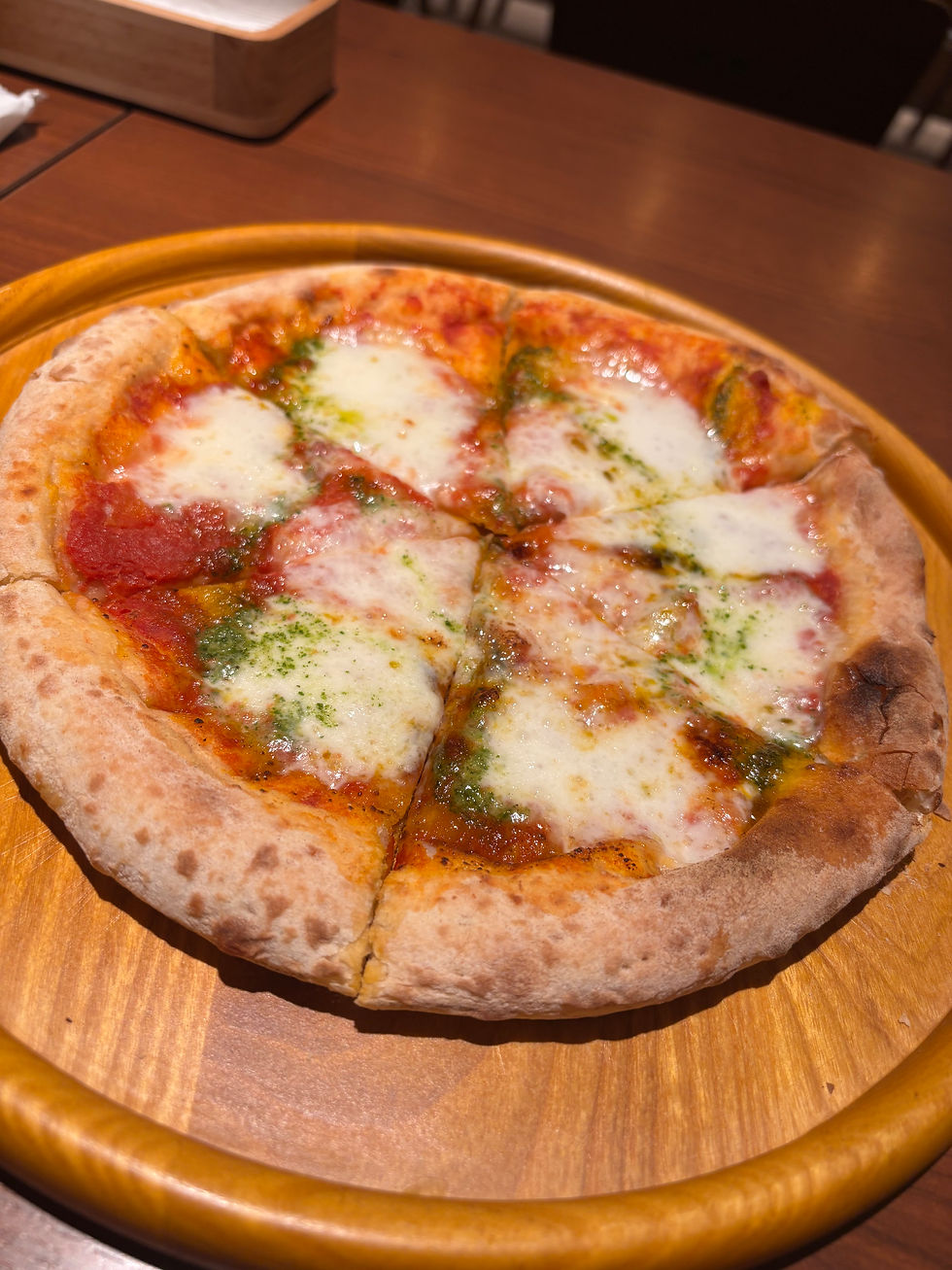
Kuro Vitto is located in the Hotel Miyajima Villa near the ferry port and open late, which on an island where most restaurants close by early evening makes it valuable for another reason entirely beyond the food. The restaurant is casual, welcoming to non-hotel guests, and built around a menu that mixes Japanese ingredients with European technique in ways that feel natural rather than forced.
I ordered the oyster pizza, the dish for which Kuro Vitto is best known on Miyajima, and the one that makes the most local sense. Hiroshima Prefecture oysters on a wood-fired pizza base: the briny sweetness of the oyster against the char of the crust, the cheese providing the richness that holds everything together. It is not a combination that requires justification when the oysters come from water you can see from your table.

Dessert was green tea ice cream alongside Japanese butter cake. The ice cream's slight bitterness was a counterpoint to the warm sweetness of the cake, a combination that manages to feel both completely Japanese and universally satisfying. I ate it slowly, not wanting the evening to end.
The First Ferry Out

I took the first ferry of the morning.
Before boarding, I sat on a bench at the water's edge and watched the bay in the early light, the hour before the other visitors arrive, before the oyster stalls open and the queue forms at Yakigaki No Hayashi, before the ferry disgorges its first load of day-trippers onto Omotesando Street. The island was quiet. The torii gate stood in the bay, lit softly by the morning light, its base already beginning to disappear beneath the returning tide.
I had walked to that base the previous evening. I had touched the wood. I had stood in the water that now covered the mudflats again as though they had never been exposed, as though my footprints in the wet sand had never existed.
The tide had come back, as tides do.
There is something in that rhythm that resists easy metaphor and invites it anyway. And sitting there in the early morning quiet, watching the water reclaim what it had briefly surrendered, I found myself thinking about the gate itself, not as an architectural marvel or a tourist landmark or even a UNESCO World Heritage Site, but as something more elemental.
The gate does not negotiate with the tide. It does not yield when the water rises or pursue when the water falls. It simply stands, as it has stood for eight hundred years, in exactly the same place, with exactly the same purpose. The water comes. The water goes. The gate remains.
There is a kind of faith in that image. The circumstances of life move around us the way the Seto Inland Sea moves around that gate, rising until what we love seems submerged and unreachable, receding until what we feared was lost stands before us again, touchable, solid, exactly where it always was. The gate does not chase the water when it retreats, and it does not flee when the water returns. It simply is. Immovable. Faithful. Present in every tide. Like God.
I have stood before structures that inspired awe through their scale and their beauty. This was different. This was a camphor wood gate, fifty feet tall, holding itself upright by gravity alone in a tidal bay, teaching something about stillness and faith that I am still learning.
The ferry horn sounded. I picked up my bag and walked toward the dock, and the island returned to itself behind me.
Practical Information
Getting there: Ferry from Miyajimaguchi, approximately 10 minutes. From Hiroshima Station take the JR Sanyo Line to Miyajimaguchi (approximately 25 minutes). Japan Rail Passes cover the JR West ferry service. For the Great Torii ferry route — which passes close to the gate — take the JR West service between 9:10am and 4:10pm.
Tides: Check tide times before you go. The Japan Meteorological Agency website (jma.go.jp) provides accurate forecasts. If you are planning a day trip, arrive at high tide to see the gate floating; plan to stay until low tide to walk to its base. The difference between the two experiences is significant enough to justify staying overnight.
Staying overnight: Strongly recommended. The island empties of day visitors after the last ferry, and the shrine at night, illuminated, quiet, with almost no other people present, is a completely different experience from the afternoon crowds. Several ryokan are available; book well in advance for weekend stays. My experience staying at Furuya Ryokan in Atami, one of Japan's finest onsen ryokans, is covered here.
Itsukushima Shrine admission: ¥300 for adults.
Miyajima Ropeway: ¥1,800 round trip to the upper station of Mount Misen, followed by a 30-minute walk to the summit. Not to be skipped if time allows.
Deer: Do not feed the deer. They are sacred, they are healthy, and they will eat your map.


Comments