Tracing A Colonial Past - A Visit to Accra
- The Anonymous Hungry Hippopotamus
- May 11
- 4 min read

Long before it became the capital of an independent nation, Accra was part of the Gold Coast, a place shaped by trade, colonial ambition, and the early foundations of a nation that would eventually lead Africa into independence. The streets, forts, and landmarks that remain today are more than historical sites; they are echoes of a complex and difficult past that still informs Ghana’s identity.
To walk through Accra with this history in mind is to see the city differently. This journey through pre-independence and modern Accra explores the places and stories that helped me more deeply understand both the past and how Ghana became the nation it is today. (Discover more on this in my last post.)

Set along the Atlantic edge of Accra, Jamestown is one of the city’s oldest and most layered neighborhoods. It is a place where history is not preserved behind glass, but lived in, walked through, and felt at every turn.

Jamestown began as a colonial trading post in the 17th century, centered around Fort James. Like many coastal settlements along what was once known as the Gold Coast, it became deeply entangled in the transatlantic slave trade.

Main Entrance to Jamestown Fort
From here, enslaved Africans were held in coastal dungeons until they were transported across the Atlantic under brutal conditions.

Steps to the Dungeon
These holding spaces were dark, confined, and airless. They remain one of the most sobering aspects of Jamestown’s history and a stark reminder of the human cost embedded in the foundations of the area.

Originally built in the 19th century and later reconstructed, the Jamestown lighthouse once served as a navigating point for ships at night. Today it serves as a historical monument and a reminder of what this community has endured over the years.

First Drinking Fountain
Among Jamestown’s lesser-known historical features is one of Accra’s earliest public drinking fountains, introduced during the colonial period. Like many elements of Jamestown, it reflects a blend of imposed colonial systems and local adaptation.
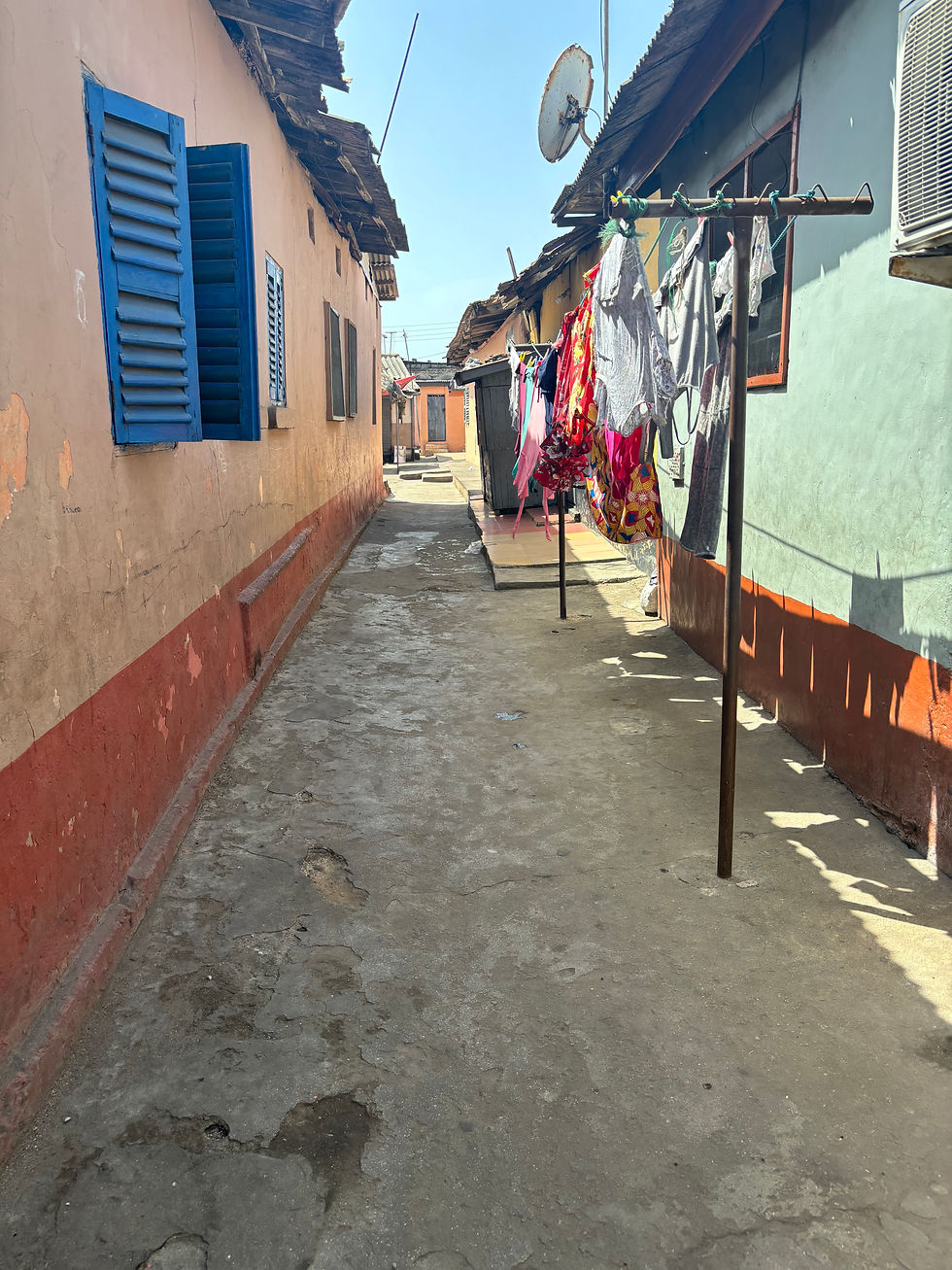
Walking through Jamestown, you quickly notice its tight, winding network of streets and alleys. These were not accidental. The layout made navigation difficult for outsiders and allowed residents to move quickly and discreetly. During the slave trade, the design helped Ghanaians evade captors or authorities.

Today, these same streets create a sense of discovery, where each turn reveals something new, from murals to markets to moments of everyday life.

Jamestown’s architecture tells another story, one of community over privacy.

Traditional homes have individual living quarters for families, but are built around shared courtyards and communal bathrooms and facilities.

This design fosters constant interaction, collective responsibility and a strong sense of neighborhood identity. It’s a way of living that contrasts sharply with individualistic, Western housing models that emphasize independence, individuality and autonomy.

Today the Jamestown community is full of life. Despite its heavy history, Jamestown is anything but static. It is alive, vibrant, creative, and constantly evolving. One of its most famous modern features is its boxing culture. In Jamestown, local gyms like the one above, train local, young fighters.
In Jamestown, boxing has become both an outlet and a source of pride and talent. The neighborhood has produced several, elite, world champions.
Then there’s the music. You can hear it before you see it. The rhythms drift through the streets, gathering people together. Whether it’s an organized performance or something more spontaneous, music in Jamestown feels communal, immediate, and deeply rooted.

In Teshie, a coastal suburb of Accra, I discovered another surprising tradition that originated in the 1950's. In an outdoor market, I found enormous, brightly painted and highly detailed recreations of familiar objects. There was a Nokia phone that was at least seven feet in height, ...

... a cacao pod that was equally large, ...

... and a bottle of soda. Though they were all carved and painted beautifully, I couldn't figure out their purpose. I opened this one and thought I had it nailed (no pun intended - explanation is forthcoming).

I figured they were all cabinets, but the artist who created them quickly showed me that the shelves were removable, and not the true function of the constructs.

He led me to this giant chili pepper which solved the mystery.

They were all coffins. Yes, coffins!

Ghana is the birth place of these,"fantasy coffins," or abebuu adekai (“proverb boxes”), as they are called. Among the Ga, a major ethnic group in Ghana, the design acts like a visual “proverb” about the person’s life, telling a story even in death.

Not only are the coffins chosen to be a statement regarding the life or occupation of the departed, they are also a status symbol, as they are all custom made and quite expensive. They are now one of Ghana's major cultural exports.
That wraps up my non-food adventures in Accra. Next, I'll share my favorite restaurants and the delicious dishes that I tasted and learned how to make while in the country. Thereafter, I travel west 100 miles to visit numerous coastal towns in Ghana. See you soon.


Comments