Tarifa to Tangier: Moments in Morocco
- The Anonymous Hungry Hippopotamus
- Jan 12
- 5 min read


Morocco lies in the northwestern corner of Africa and is the most visited country on the African continent. This was my first visit to the country and my opportunity to be one of the approximately 17.4 million international visitors that Morocco welcomes yearly.


Situated at the Strait of Gibraltar, Morocco is Africa's gateway to Europe. It's so close that I hopped on a ferry from Tarifa, Spain and 9 miles later, I was in Tangier, Morocco, a totally different country on a completely different continent. How's that for efficient travel?


Port de Tanger Ville
The city of Tangier has two ports. The Tangier Med port is a deep water port that opened in 2007. Its location at the point of the Moroccan Coast nearest the Iberian Peninsula is ideal because it connects trade routes between Europe, the Americas and of course, Africa.
The other is the Port de Tanger Ville, or Tangier Ville Port, located close to the city center and the historic Tangier Medina and Kasbah. This is where my ferry dropped me off.


A short walk across the street and I arrived at the Tangier Medina, the ancient, walled, old city.
Religion


We docked and made our way to the medina during Adhan, or the Muslim call to prayer. Since Islam is both the official and predominate religion in Morocco, you will hear Adhan announced by the muezzin (the person who recites the Adhan) and then broadcast five times a day from the minarets, or tall, slender towers across the city.
The minaret, usually attached to a mosque, serves as a landmark and a symbol of Islam's presence in a community. The minarets are easily recognizable once they are pointed out, as they were to me in Israel, Dubai and now here in Morocco.


Mosques abound in Tangier. This is the entrance to one that was under repair. The vibrant green is considered a sacred color in Islam, associated with garments worn by Muhammad and is also associated with descriptions of paradise in the Qur'an. The color was indeed striking, but I was more taken with the mosaic of zellige tiles.

The Kasbah Mosque
Of all the mosques I passed, the Kasbah Mosque is the most famous in the Tangier Medina and is a key, historical, Islamic site. The mosque was established in the late 17th century by Moulay Ismail and rebuilt under Moulay Slimane.

Beit Yahouda
While Islam is the predominant religion, it is not the only religion practiced in Tangier or Morocco. The Jewish religion also has deep roots in Tangier beginning with the settlement of Jews as early as the 5th century BCE and continuing with a new wave of Sephardic Jews after 1492. The Sephardic culture blended Andalusian and Moroccan traditions and its impact is still visible in Tangier today.

Beit Yahouda
For example, close to the Kasbah Mosque, you will find Beit Yahouda, a beautifully restored Sephardic synagogue. It no longer operates as a synagogue though. Instead, it has been transformed into a museum with exhibits, artifacts and architecture about the Jewish diaspora, celebrating the rich, Jewish history and culture in Northern Morocco.
The Medina


The architecture in Tangier had quite an impact on me. I even incorporated elements, including zellige tiles and glass, fanous lanterns, in my own home. I loved this hand-carved door with its decorative studs and intricate, high relief carvings as well, but that definitely would have been too much for my humble abode.


As I have mentioned, I saw these historical and religious sites in the Tangier Medina. Medinas are walled old quarters, characterized by their maze-like streets, historic buildings and colorful markets, or souks. They are common in North Africa.
Weaver's Market (Fondouk Chejra)
On the edge of the Tangier medina, you will find the open-air, fondouk chejra, or weaver's market. For over 150 years, artisans have been operating the foot pedals of these wooden looms and creating luxury rugs, carpets, bags, towels and blankets. Inside one of the 50 or so workshops that line the walkways, I found a gorgeous, handira, or woven, tasseled blanket that is now draped over the couch in my living room and reminds me of my trip to Morocco daily.

Elsewhere in the medina you will find various souks. The one pictured above sold all manner of foods ...


... while this one specialized in legumes and grains, ...

Spice Souk
... this one in spices ...


Date Souk
... and this one in dates.
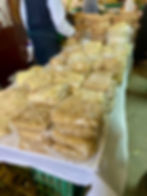
My favorite were the bread vendors. If I haven't mentioned it, bread is a weakness of mine when it is freshly baked and well made. I could happily make an entire meal of it.
Msemen
For that reason, I was mesmerized by this vendor who was making msemen, a traditional, Moroccan flatbread. The dough is stretched and applied to the heated surface very thinly and then layered with butter and often served with honey, jam or cheese. It was delicious. I restrained myself from having more than a few bites because it was time for lunch.

The midday meal was served inside an airy restaurant, with brightly colored couches and mosaic tiled walls.

Khobz
Lunch started with khobz, a whole wheat bread with a hearty flavor and soft interior.

Harira Soup
The bread could be eaten alone, with butter or alongside harira soup. Harira is a savory soup, loaded with lentils and seasoned with fresh herbs, turmeric, ginger, cinnamon and cumin.
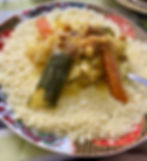
Seksou
Next, we were presented with seksou, or couscous, on top of which were a variety of sautéed vegetables and chickpeas.

Qotban
The main course was chicken brochettes and qotban, which are spicy, grilled lamb kebabs. All the meats were richly seasoned with aromatic spices such as ras el hanout, garlic, cumin, turmeric and paprika.
While we enjoyed our feast, a live band played next to us.
Achakkar Beach

After a lovely meal, we stopped at Achakkar Beach, which lies on the Atlantic Coast. The beach is known for its golden sands, and clear turquoise waters.

It is also known as a great location for a camel ride, so I jumped aboard and took in the views while riding up and down the windswept beach on the back of a camel. This was my second camel ride (the other was in Dubai), and I was again shocked by just how high off the ground I was once the camel was standing up, straight and tall.
Cape Spartel

Cape Spartel is a promontory point less than 10 miles from Tangier, which is where I was headed next. The location features the Cape Spartel lighthouse, built in 1864 and still operational today.

The beautiful lighthouse aside, this is also a special location for another reason. Morocco is the only African nation with Atlantic and Mediterranean coastlines. From Cape Spartel, you get panoramic views as you watch the waters of the Atlantic and Mediterranean blend.
Caves of Hercules

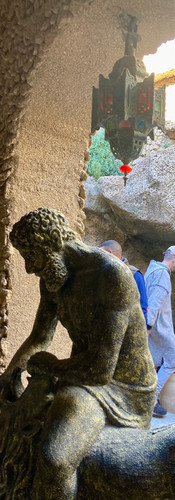


My next stop was at the Caves of Hercules. This network of limestone caves is linked with the mythological Hercules and said to be the place where he rested after completing his Twelve Labors. The caves opened to the public in 1920 and have since drawn many visitors. To be honest, this was my least favorite stop in Tangier as it seemed like somewhat of a tourist trap. That is, with one exception.

Map of Africa
The main cave has one sea-facing opening that is shaped like the continent of Africa. This unique feature has made this cave one of the most photographed places in Morocco. I hear that the optimal time to visit is at sunset when the shadow of the opening casts gorgeous reflections on the Atlantic waters, while the golden, filtered light illuminates the cave's interior.

Sadly, I was not able to stay until sunset. I had a ferry to catch back to Spain that was not going to wait. Whether you dedicate a trip to Tangier or stop over during a trip to Spain as I did, I recommend a visit. I am excited to return to Morocco one day to discover its many other cities and spend more time taking in the vibrant culture.