Detroit Food Guide: Coney Dogs, Detroit Pizza and Local Legends
- The Anonymous Hungry Hippopotamus
- Aug 19, 2025
- 4 min read
Two of Detroit's most iconic foods are hot dogs and pizza. Detroit pizza I had heard of prior to my visit, but the hot dogs were new to me. During my stay, I learned that there is a hot dog that was born in Detroit. Though it is served in other parts of the country like New York, Illinois, Florida and Ohio (where it is made with their special Cincinnati chili) for example, when offered, it is sometimes referred to as a Michigan dog.

In Michigan, the hot dog is called a Coney dog. Confusing because it didn't originate in Coney Island (the birthplace of the American hot dog), right? The story goes that the Greek brothers who brought it to Detroit, came through Ellis Island. As they passed through New York, they encountered the New York hot dog and named their version after the city's famous Coney Island.
The Coney dog is made using a beef frankfurter, topped with bean-less chili, (referred to as Coney sauce) diced onions and yellow mustard. Who has the best Coney dog in Detroit? It boils down to a showdown between American Coney Island and Lafayette Coney Island, located right next door to one another.
American Coney Island

American Coney Island opened first.

It was launched on West Lafayette Street in downtown Detroit in 1917 by Gust Keros and his brother William, both Greek immigrants.

The restaurant still stands in that same location today.

American Coney Island continues to be family owned and today, is operated by the third generation of the Keros family.
American Coney Island makes its hot dog with a snappy casing, slightly sweet chili, sweet onions and tangy, yellow mustard.
Lafayette Coney Island

Lafayette Coney Island
Right next door, you'll find Lafayette Coney Island, which opened in1924, several years after American Coney Island. When the Keros brothers had a falling out, William decided to leave the American Coney Island partnership and open his own diner, Lafayette Coney Island, steps away.
Today, Lafayette is no longer family held, but is still wildly popular. The ambiance is livelier, louder and very diner-style as opposed to the more refined experience you'll have next door at American Coney Island.

The Lafayette Coney dog is very, very similar to that of its neighboring restaurant. It also uses an all beef hot dog, placed in a steamed bun.
The chili at Lafayette is a bit spicier however, the onions more course and the hot dog itself is more seasoned.

Both restaurants also offer a Coney dog with cheese that is quite delicious. Visit both establishments yourself and cast your vote in the debate as to who has the best Coney dog in Detroit. You'll be witness to a rivalry that has been going on for more than 100 years and has even captured the attention of television shows like Man v. Food, The Travel Channel and Food Wars.
(By the way, if you love hot dogs, check out my hot dog adventure in Chicago as well.)
Buddy's Pizza
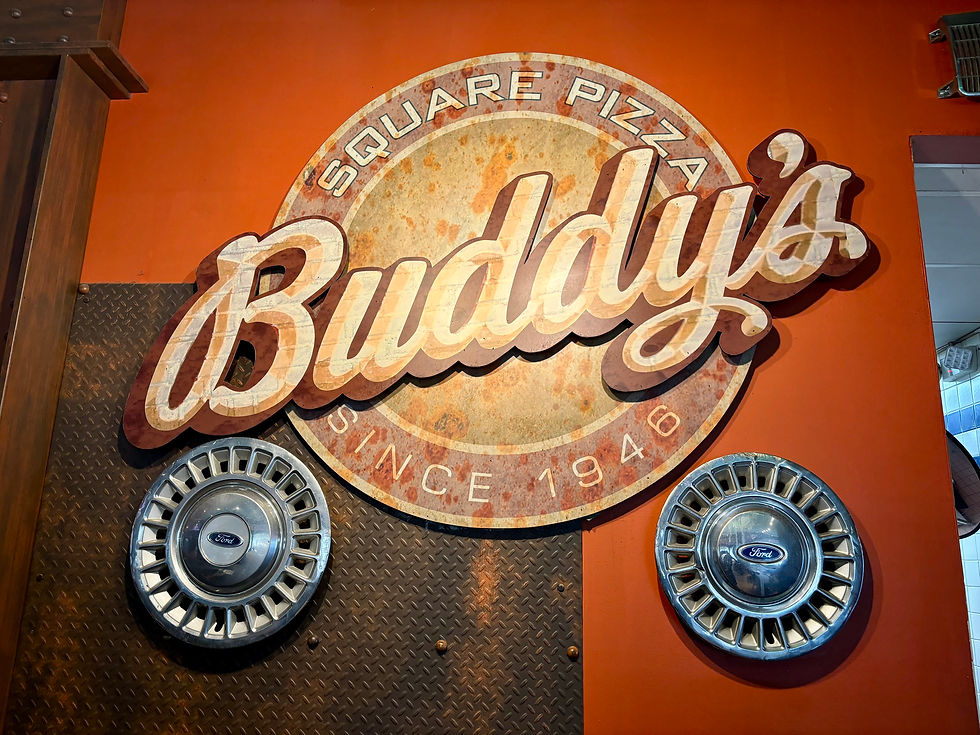
While Detroit has made a mark on hot dogs, the city's most iconic food is their pizza. It seems like pizza has endless iterations - thick crust, thin crust, stuffed crust, Neapolitan, Roman, Chicago style, New York style ... and then there's Detroit style.

Buddy's
I was told the place to try this marvel was Buddy's, a restaurant that has been serving up Detroit-style pizza longer than any restaurant in the city or the United States. Gus Guera opened Buddy's Rendezvous Pizzeria (now simply called Buddy's) in 1946 and debuted his square (or rectangular) pie, influenced by Sicilian-style pizza.
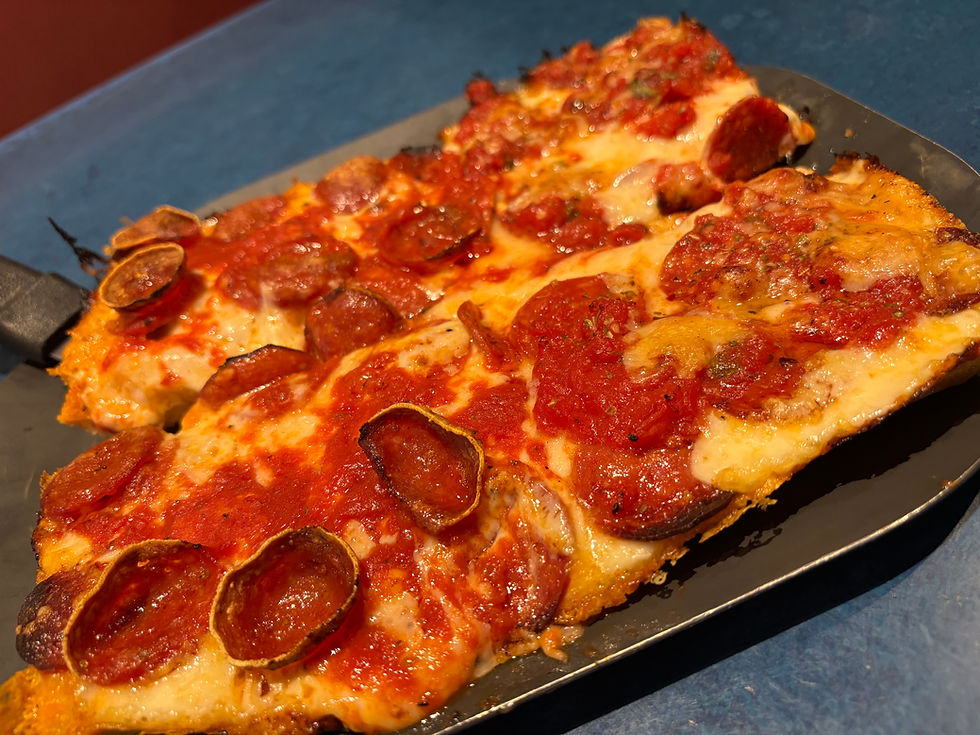
In addition to its shape, what sets Detroit-style pizza apart is the crust, which is chewy, airy and famously crispy along the edges. That is because the pizza is baked in square or rectangular pans made of forged steel from local automotive plants. Seems very appropriate since the pizza was birthed in Motor City.
Other unique traits of the pizza are that the red sauce is spooned on top of the cheese and most toppings - a backwards layering process, if you will. The main cheese, Wisconsin brick to be specific, is a key characteristic because it is ample and is layered all the way to the corners of the pan so that it crisps and caramelizes when it comes in contact with the hot metal.
Detroit Public TV and Detroiter Pizza
I was told to try the two most popular pizzas at Buddy's, both featuring pepperoni. I wasn't mad at that. The first was the pizza that started it all, the Detroit Public TV, made with what they call their Motor City cheese blend, red sauce and crispy, Old World pepperoni. The second was the Detroiter, also made with pepperoni buried beneath tomato basil sauce seasoned with Buddy's Sicilian spice blend, and a blend of Wisconsin brick and Parmesan cheeses.
Both pizzas were delicious, as were the hot dogs, if I didn't say so earlier. That is also true of everything else I ate in Detroit. I'll share those other dishes in my next post when I visit some of Detroit's most heralded restaurants.



Comments