Bangkok Part 2: Thai Cooking Class
- The Anonymous Hungry Hippopotamus
- Dec 8
- 5 min read
My trip to Thailand gave Japanese food a run for its money as my favorite cuisine. Though Japanese still remains my favorite, Thai cuisine is now a very, very, very close second. I'm not speaking only about the ubiquitous pad thai or green curry you've had at every Thai restaurant in the United States (though I am going to cover those dishes in this post).
I am talking about both Thai dishes I had never heard of before, as well as staples I just mentioned, that were so good in Thailand that I am disappointed when I order them at Thai restaurants in the U.S. now. The flavors sadly, just don't compare.
One of my favorite adventures in Thailand was a cooking class I took in Bangkok. Shopping for and making several dishes from scratch helped me understand the unique flavors and ingredients available in Thailand and how they coalesce to create elevated dishes that are so unique to the country.

House of Taste Thai Cooking School
Of the many cooking schools in Bangkok, I chose House of Taste Thai Cooking School based on reviews, availability and proximity to my hotel. I had a great experience.

Bangrak Market
Prior to cooking our meal, we headed to the local, outdoor market to procure all of our ingredients. Though I came ready with a list in hand, I forgot about it very quickly, lured in and distracted by all the fresh produce that was not on my list.

Ma Yong Chit
I was particularly drawn to those items that aren't as readily available in the U.S., such as ma yong chit, or plum mango. This entire fruit is edible and offers a distinctive sweet and sour flavor. If you like tart flavors, this fruit is right up your alley.
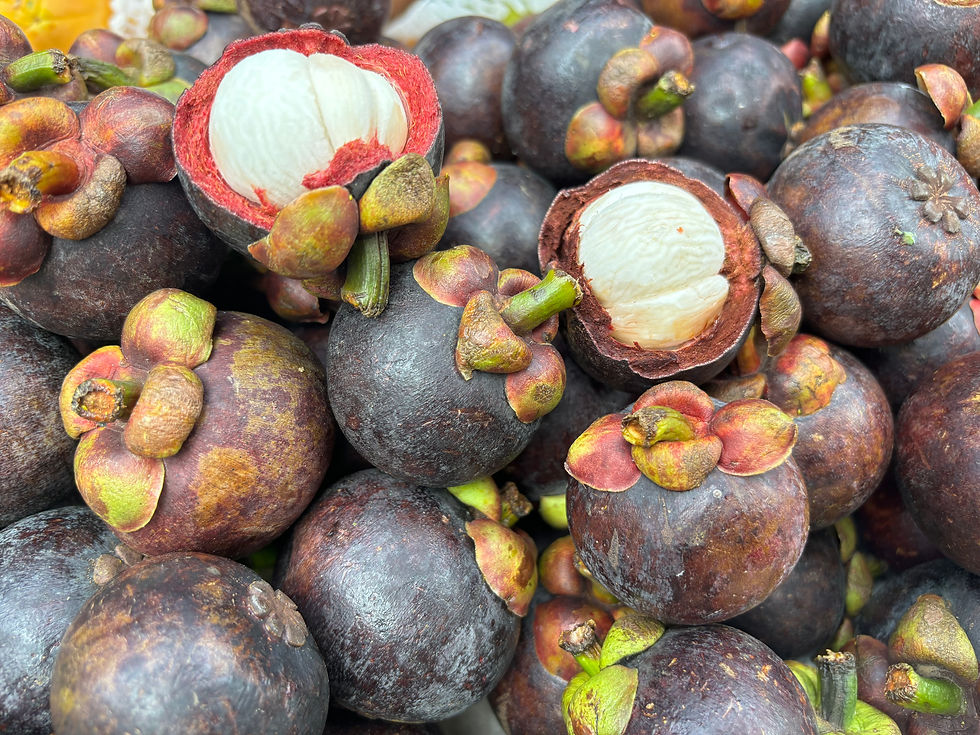
Mangosteen
I also got to sample some mangosteen. Peel the outer skin and inside you will find sweet, tender, white segments that have flavors of strawberry, lychee and peach.

There was also no dearth of prepared meats at the market. We sampled several varieties of fried fish, sausages and roasted meat skewers. After sampling several items, I got back on track, filled my basket with the ingredients I actually came for, and we headed back to the cooking school to start making our meal.
Coconut Milk
The first item we made was coconut milk, which would be used in three of the dishes we were going to prepare. Making coconut milk was a completely new experience for me, as up to this point, I had only cooked with coconut milk that came out of a can.
At the cooking school, I learned how to make coconut milk from scratch. We started by grating fresh coconut meat and adding hot water. From there, it was all about mixing the two ingredients together and squeezing to extract the milk.

Coconut Milk
The process was not at all quick, but all that time and effort we invested rendered a creamy, rich product that far surpassed canned coconut milk in flavor and texture.
Tom Kha
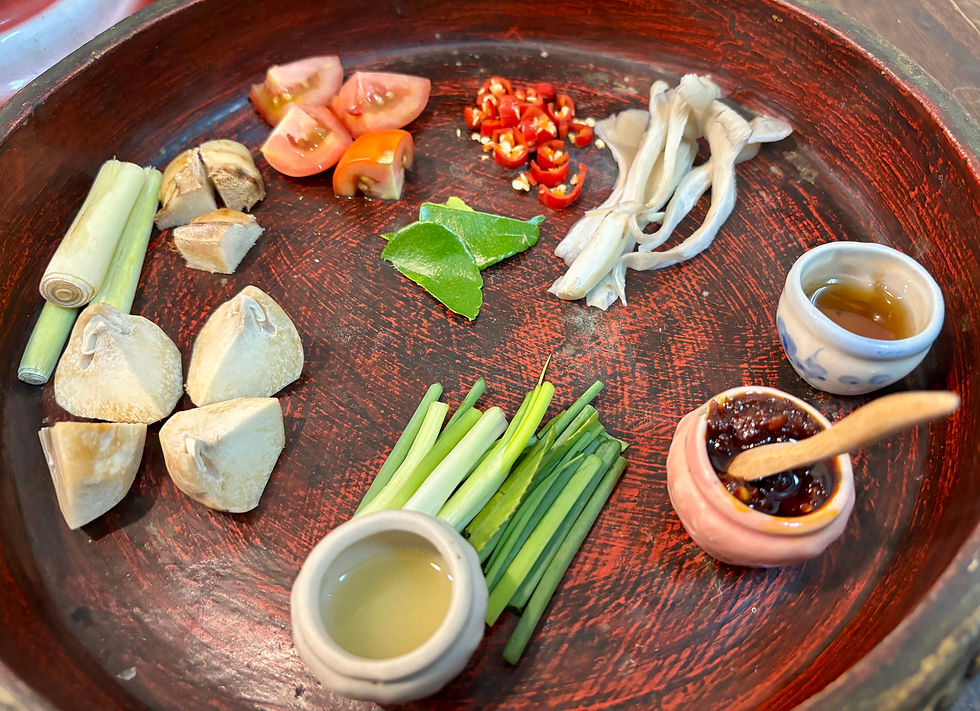
The coconut milk would serve as the base of our first dish, tom kha. In Thai, "tom" means "to boil," and "kha" means "galangal." Galangal is a fragrant, knobby, spice from the ginger family that imparts the predominant flavors to this soup, which are citrusy, floral and peppery.
In addition to the galangal, all of our other ingredients went into our wok to simmer. They included, fresh lemongrass, tomato, mushrooms, chilis, keffir lime leaves, fish sauce, lime juice and palm sugar.

Tom Kha
Once the ingredients came to a boil and the mushrooms were cooked through, we added the fresh coconut milk and then garnished with green onion.
Pad Thai

Next, we moved onto making our pad thai, a dish that has a rich story of nationalism behind it. Pad thai was promoted by Prime Minister Plaek Phibunsongkhram in the 1930s to serve as the national dish of Thailand. The prime minister's goal was two-fold. First, it was to unify the country and second, to address a national, war time, rice shortage.

The first ingredients in our hot wok were tofu, shrimp, garlic and chili flakes.

Once the garlic became fragrant, we added in rice noodles that had been soaked in room temperature water until pliable. We then added the pad thai sauce made of fish sauce, palm sugar, and tamarind paste. These flavors are the magic of pad thai because the balance of sweet, salty and tart brings that complexity that leaves you craving more.
We mixed all of those ingredients until the noodles were coated and then pushed them all to one side of the wok and cracked and scrambled an egg into the center and hottest part of the wok. When the scrambled egg was completely cooked, we folded it in with the other ingredients.

Pad Thai
From there, all that was left was to garnish the noodles with bean sprouts, green onion, chili powder (if you like spice like I do) crushed peanuts and a squeeze of lime.
Kaeng Khiao Wan

Our next dish incorporated more of our homemade coconut milk. The dish is called kaeng khiao wang which translates to "sweet green curry." The "sweet" refers to the pale, green color of the curry, not to the taste.

In fact, this dish is made to be on the spicier side due to the incorporation of green chilis (both serrano and Thai) which impart the lovely color. Those green chilis are added to shallots, galangal, lemongrass, makrut lime zest, garlic, shrimp paste, and salt and pounded together using a mortar and pestle.

Green Curry Paste
Our labor yielded a bright green curry paste that until then, I had only seen with a greyish, brownish tinge in a jar at my local, grocery store. This homemade green curry paste tasted and smelled far better.
The paste was placed in a hot wok with some oil and sautéed to release all the flavors. The fragrance made my mouth water.
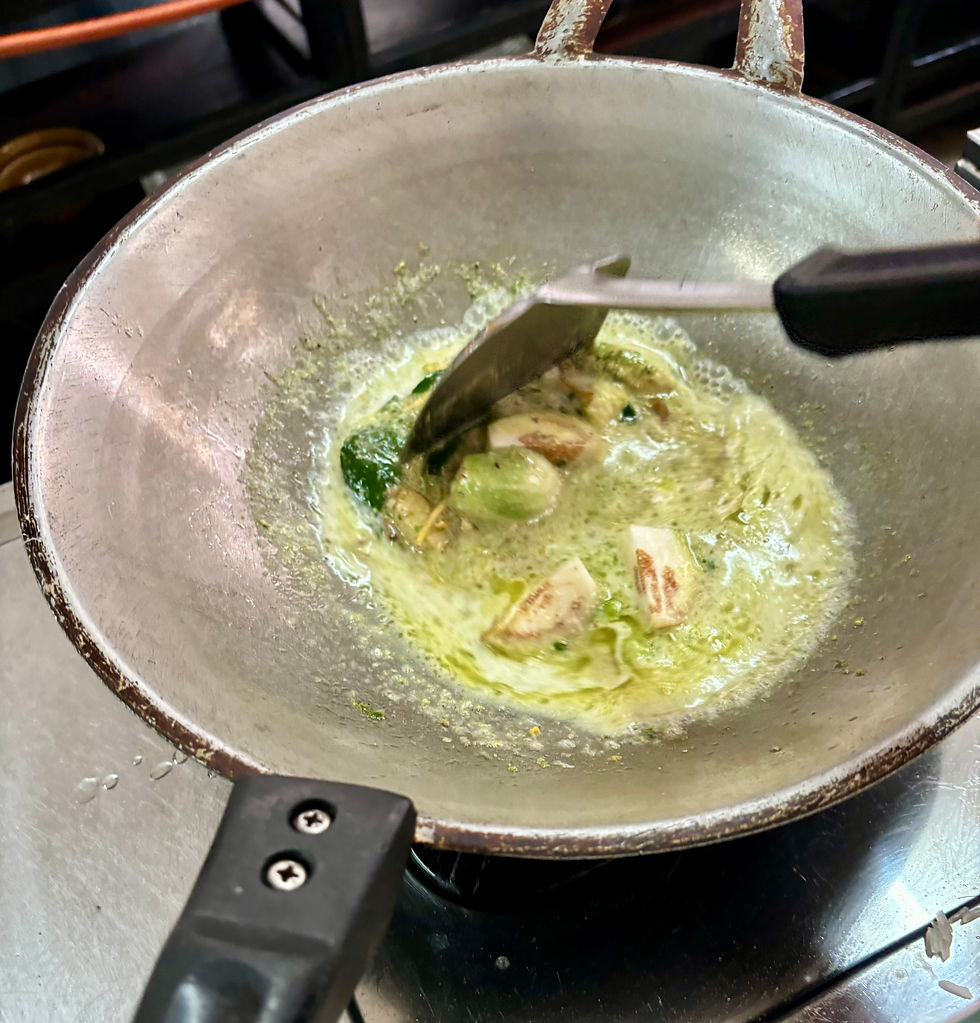
To the warmed paste we added our coconut milk, eggplant, and chicken and let the curry simmer, stirring until everything was cooked through and tender.

Kaeng Khiao Wang
For garnish, we added fresh, Thai basil leaves ...
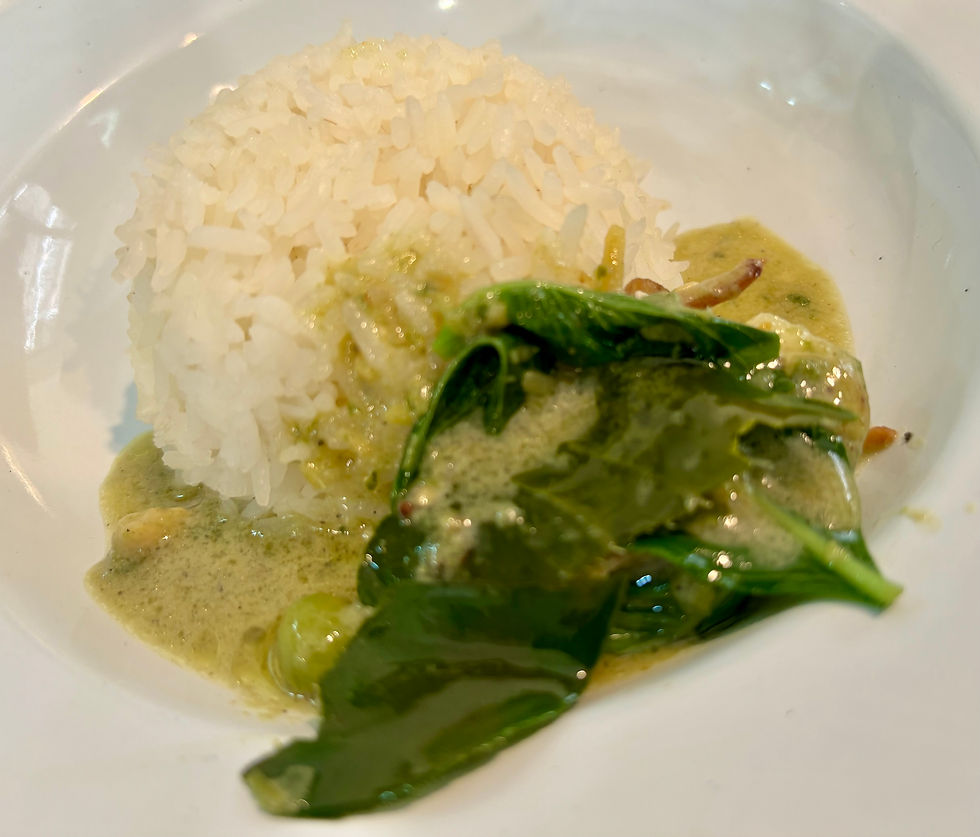
... and served the finished curry with warm, jasmine rice.
Khao Niao Mamuang
Our final dish, khao niao mamuang, used the last of our coconut milk, part of which we brought to a simmer. "Khao niao" means "sticky rice" and "mamuang" means "mango."

First, we focused on the khao niao, which we made by adding Thai sweet rice, sugar and pandan leaves to the coconut milk. The rice was finished cooking once it had absorbed all of the liquid, flavored by the pandan leaves, and had achieved a shiny appearance.
In another bowl, we poured the very last portion of our coconut milk, to which we added a pinch of salt and corn starch to thicken the mixture. This sauce would be served alongside the sticky rice and the star of the dish, the mamuang or mango.

Khao Niao Mamuang
To finish this desert, we scored and inverted halves of a very ripe, very tender and very sweet mango. Choosing the perfect mango is essential to this dish because the mango is what brings everything together. If your mango is subpar, it won't matter how delicious your rice or your sauce is.
After completing all four dishes, we sat down to enjoy the feast with our classmates. I don't know if it's because we worked so hard for our meal, that we were finally out of the hot kitchen and relaxing in the air conditioned dining room or because the ingredients were superior in Thailand, but this was one of the best Thai meals I have eaten. It was probably the combination of all of the above.
Coming up, I'll share several other meals that blew my mind during my time in Bangkok. Until we meet again, "Taan hai a-roi" (eat delciously)!


Comments