Saving Daylight: The Best Sunsets I've Watched Around the World
- The Anonymous Hungry Hippopotamus
- Nov 6, 2022
- 5 min read
Updated: 6 days ago
Twice a year, without consulting the sun even once, human beings move their clocks by exactly one hour and call it saving daylight — as if daylight were a thing that could be misplaced, or hoarded, or given back. The sun does not participate in this. It rises and sets on a schedule that has nothing to do with legislatures or time zones, the same schedule it's kept since long before anyone thought to name an hour. And yet every year, on the day we perform this small, collective act of pretending we control something we don't, I find myself thinking about all the evenings I've actually stopped to watch it happen — not manage it, not save it, just watch it end.
Florence is in that list. So is Fukuoka, and Monterey, and a fortress wall in San Juan, and a river in Porto, and a headland in Phuket built for no other purpose than this. Watching a sunset has never once required me to be anywhere impressive. It has only ever required me to stop.

Florence, Italy
In Florence, the best seat for it is the Ponte Vecchio, watching the Arno turn a color no filter has ever needed to improve — orange low against the water, lavender bleeding up into blue, the city's lights just beginning to answer back in reflection before the sky has even finished.

Fukuoka, Japan
In Fukuoka, the sunset that stays with me isn't over the city at all — it's the white torii gate standing alone in the shallows at Shima-Sakurai, the sun dropping directly behind it as if the gate had been placed there centuries ago for exactly this purpose, which, in a sense, it was.
Monterey, California
In Monterey, the evening arrived almost entirely in purple — sky and ocean both, holding onto every shade of it except for the sun itself, which stayed a stubborn, singular gold all the way down. The Pacific kept crashing over the rocks in front of the bench where I sat and watched it, a light mist hanging low enough to soften every edge of the scene — the kind of haze that makes an already beautiful thing look like a memory of itself before it's even finished happening.

San Juan, Puerto Rico
In Old San Juan, the sun goes down behind the walls of Castillo San Felipe del Morro, four hundred years of Spanish stone catching a sky gone the brightest, almost fluorescent pink, the ocean below picking up the same color as if it had no choice but to agree with the sky above it.

Porto, Portugal
In Porto, the sun sets over the Douro in gold — fittingly, since legend holds the river earned its name from exactly this color, ouro being Portuguese for gold, the Dom Luís I Bridge holding its silhouette against a sky that seems to know precisely what it's named after.

Phuket, Thailand
Phuket has an entire cape, Promthep, whose only real purpose is watching the sun go down into the Andaman Sea — a headland that exists, as far as I can tell, for no reason other than this, and does its job better than almost anywhere else I've stood.
Placencia, Belize
In Placencia, the same sun sets over a lagoon instead of an ocean, the water gently lapping at the shore, unhurried, indifferent to whether anyone's watching.

Cancun, Mexico
Off the coast of Cancún, I watched an entire sunset lying on the net strung between the hulls of a catamaran, the skyline going gold and pink in the distance behind it, a warm breeze moving over the water and a dolphin surfacing nearby every few minutes, as unbothered by my presence as I was determined not to move and disturb whatever this actually was.

Oahu, Hawaii
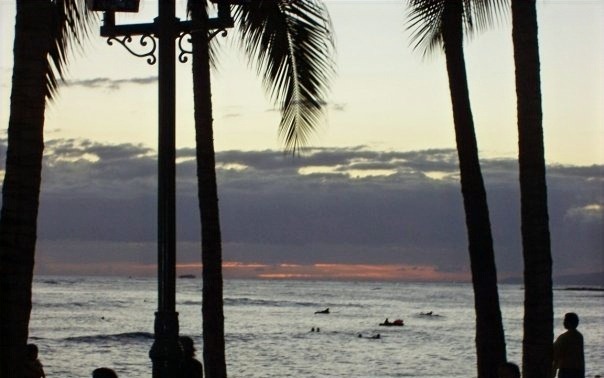
In Waikiki, I caught the sunset overexposed on purpose, the sky arranging itself into bands like something deliberately organized — orange nearest the water, then yellow, then a thin seam of lavender, then blue deepening into darker blue the higher you look, until, if you know where to find it in the corner of the frame, a crescent moon is already waiting for its turn to stun viewers.
Jaipur, India
In Jaipur, the sun drops as a perfect gold circle into a sky that stays more amber than orange, cattle grazing in the foreground entirely unconcerned with the performance happening behind them, the way the ordinary and the extraordinary in this country never seem to mind sharing the same frame.
These places aren't as disconnected as they might seem. Dollars and euros circulate through more than one of them, English gets you by in several, and cuisines have been trading ingredients back and forth across borders for centuries in ways that show up on plates from Porto to Phuket. But none of that is why they belong in the same sentence.
What they actually share is something smaller and stranger: somewhere in each of them, on an ordinary evening that would otherwise have gone unremembered, I stopped what I was doing to watch the sky do something it does every single day, everywhere, entirely without an audience. It doesn't need us to notice. It has never once needed us to notice. And maybe that's exactly why noticing feels like something worth doing — not because the sunset requires a witness, but because I do.
A sunset is, when you think about it plainly, a small daily rehearsal for the only ending that actually matters — the sun goes down, and it comes back, and it goes down again, on a loop that will outlast every person who has ever stopped to watch it, myself very much included. Daylight Saving Time is our clumsy, twice-a-year admission that we know this on some level — that we're the ones adjusting, not the sun, because we're the ones running out of it, a little, every single day, whether or not we bother to notice. The sun was never the one who needed saving. We were.
"To every thing there is a season, and a time to every purpose under heaven." — Ecclesiastes 3:1
Twice a year, I'll keep changing my clocks like everyone else, an hour forward, an hour back, playing along with a system that has never once fooled the sun. But what I actually want to save isn't the daylight. It's the habit of stopping for it — on Promthep Cape, in Old San Juan, in whatever ordinary evening comes next — because eventually, and not nearly as far off as it feels right now, there will be a last one. I'd like to have been paying attention for as many of them as I could.


Comments